
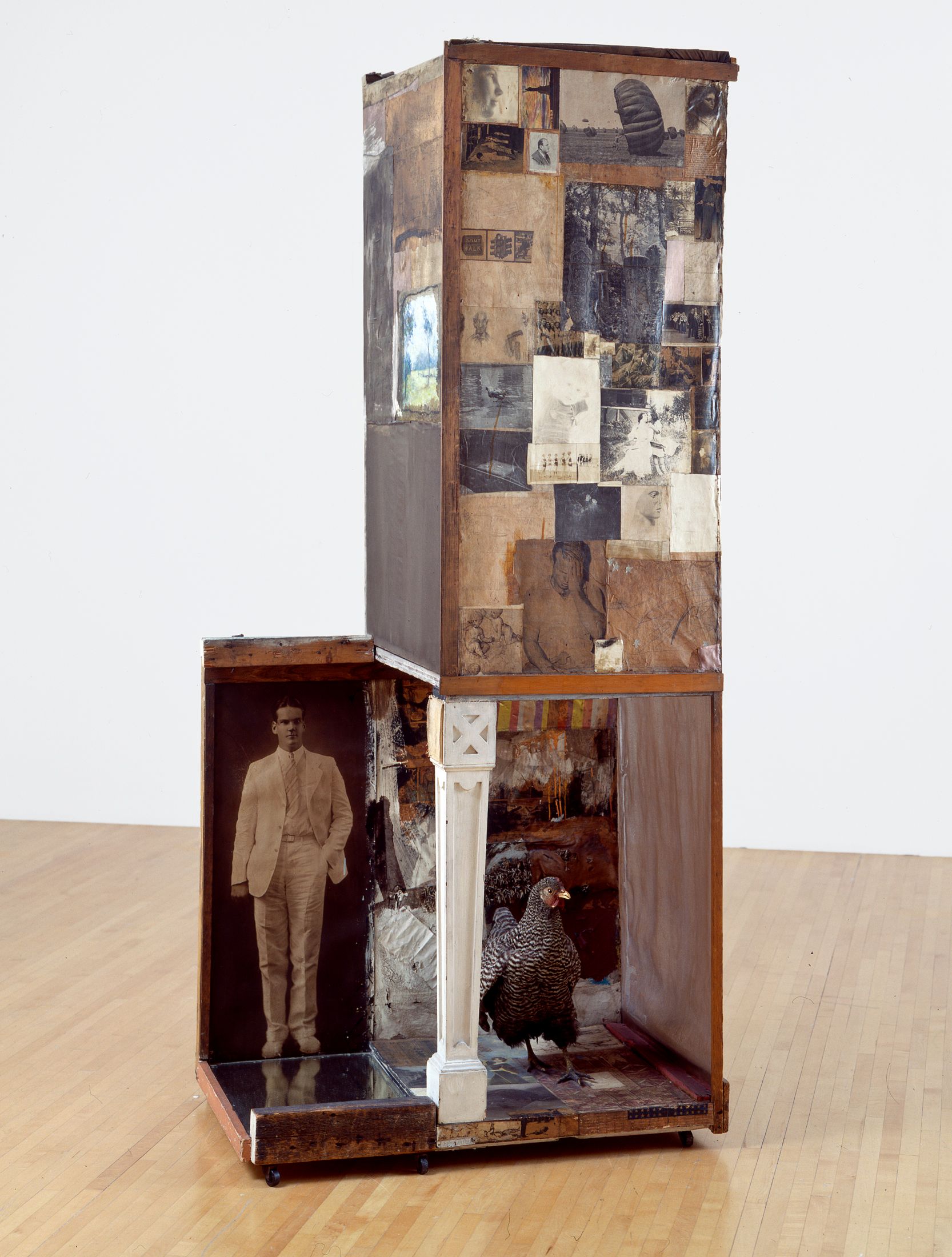
Interview, 1955
- Medium
- Oil, found painting, found drawing, lace, wood, envelope, found letter, fabric, photographs, printed reproductions, toweling, and newspaper on wood structure with brick, string, fork, softball, nail, metal hinges, and wood door
- Dimensions
- Overall: 72 3/4 x 48 x 12 in. (184.79 x 121.92 x 30.48 cm)
- Accession Number
- 85.22
- Credit
The Museum of Contemporary Art, Los Angeles The Panza Collection
Robert Rauschenberg classified Interview as a Combine, which he defined as a work that combines the mediums of painting and sculpture, in that it both hangs on the wall and projects into three-dimensional space. Rauschenberg’s Combines also recombine ordinary found objects. Art critic Leo Steinberg likened them to printing press “flatbeds,” or any surface (tabletop, studio floor, bulletin board) on which heterogeneous materials can be scattered. Interview includes photographs, a fork, a softball, various fabrics, smears of oil paint, inexpensive art prints, and scraps of wood, among many other bits of detritus, set within a loose grid. Art historians continue to debate whether a Combine like Interview alludes to urban redevelopment in downtown New York, as signaled by the brick and cast-off door, or to art’s classical past, as indicated by the reproduction of a painting of Galatea, a mythological subject, in the center, or whether it is purposefully incoherent, offering nonsense accumulations that thwart interpretation. Rauschenberg studied at Black Mountain College from 1948 to 1952.
 Robert RauschenbergUntitledc.1954
 Robert RauschenbergHowl1982
 Robert RauschenbergSub-total1971
 Robert RauschenbergAutobiography1968
 Robert RauschenbergUntitled1967
 Robert RauschenbergPost Rally1965
 Robert RauschenbergSlow Fall1961
 Robert RauschenbergXXXIV Drawings for Dante’s Inferno1959-1960
 Robert RauschenbergXXXIV Drawings for Dante’s Inferno1959-1960
 Robert RauschenbergXXXIV Drawings for Dante’s Inferno1959-1960
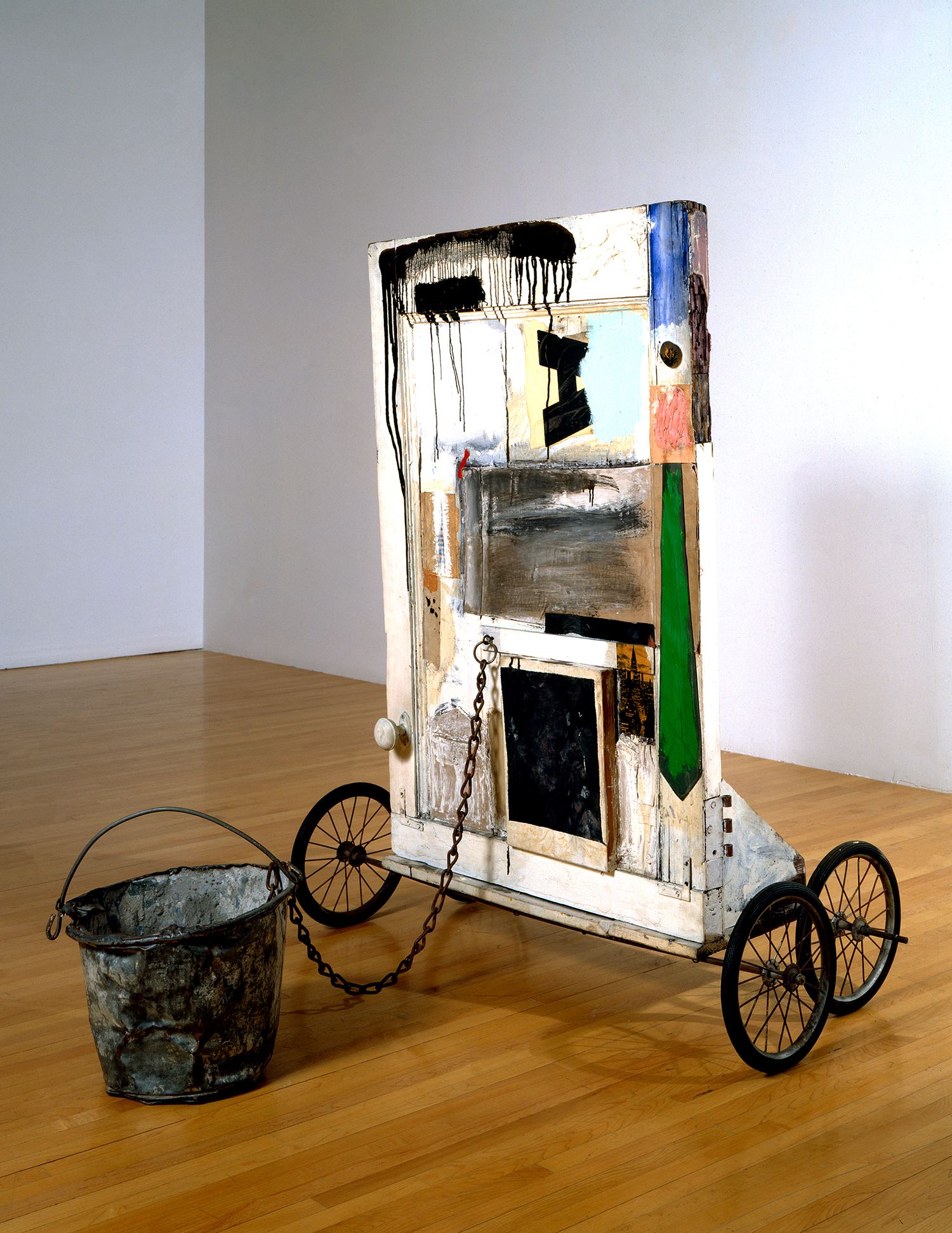 Robert RauschenbergGift for Apollo1959
 Robert RauschenbergInlet1959
 Robert RauschenbergKickback1959
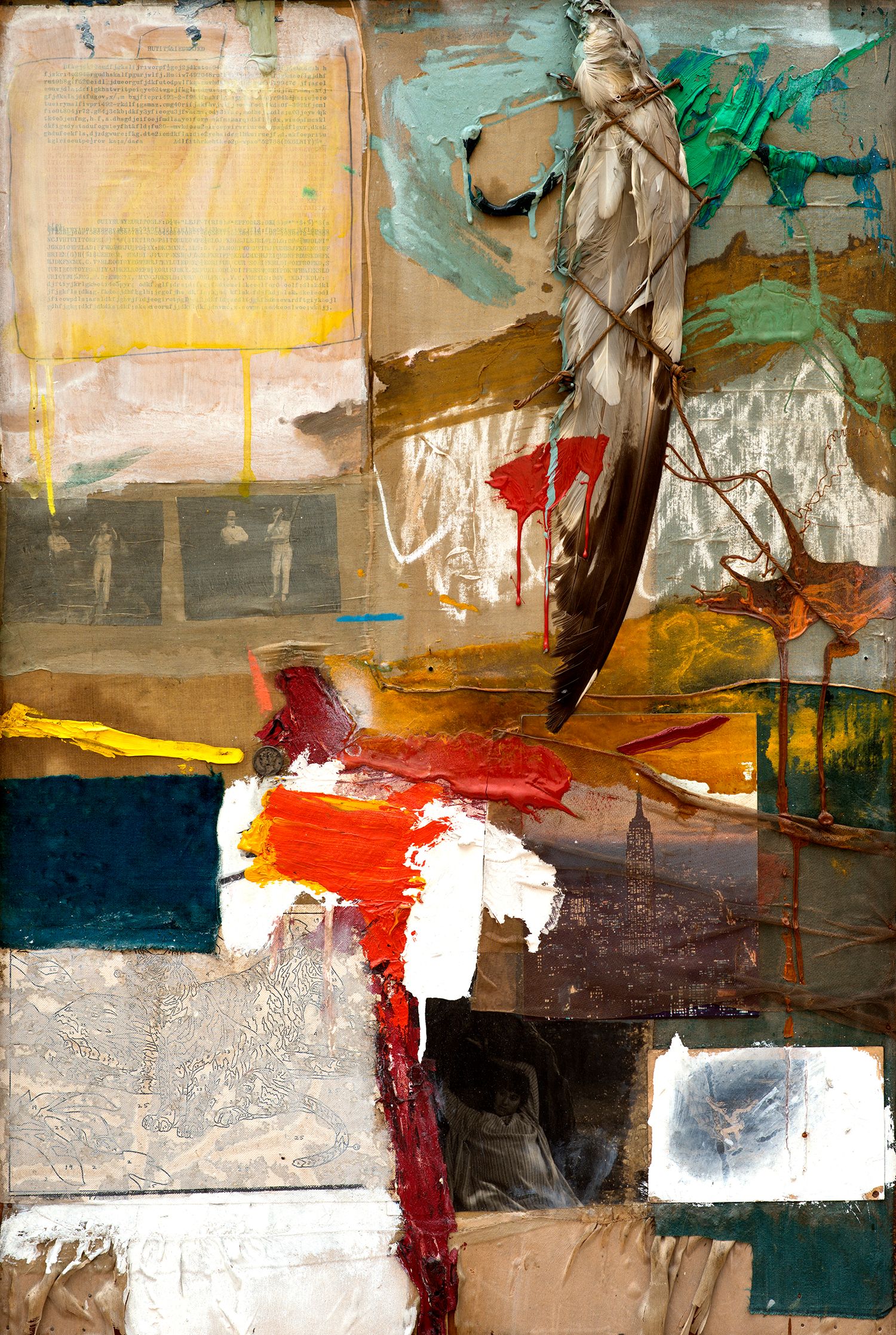 Robert RauschenbergPainting with Grey Wing1959
 Robert RauschenbergCoca-Cola Plan1958
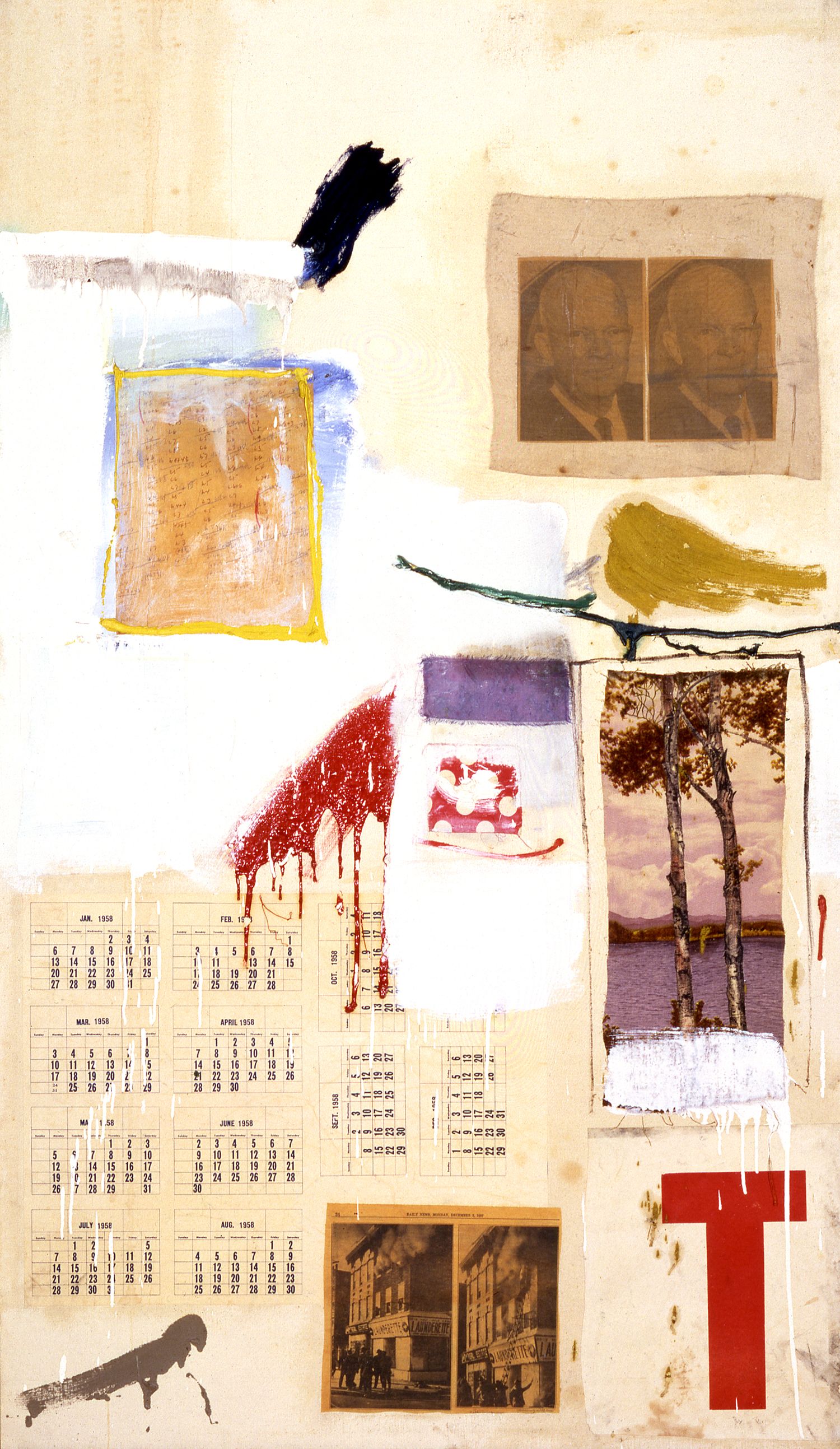 Robert RauschenbergFactum I1957
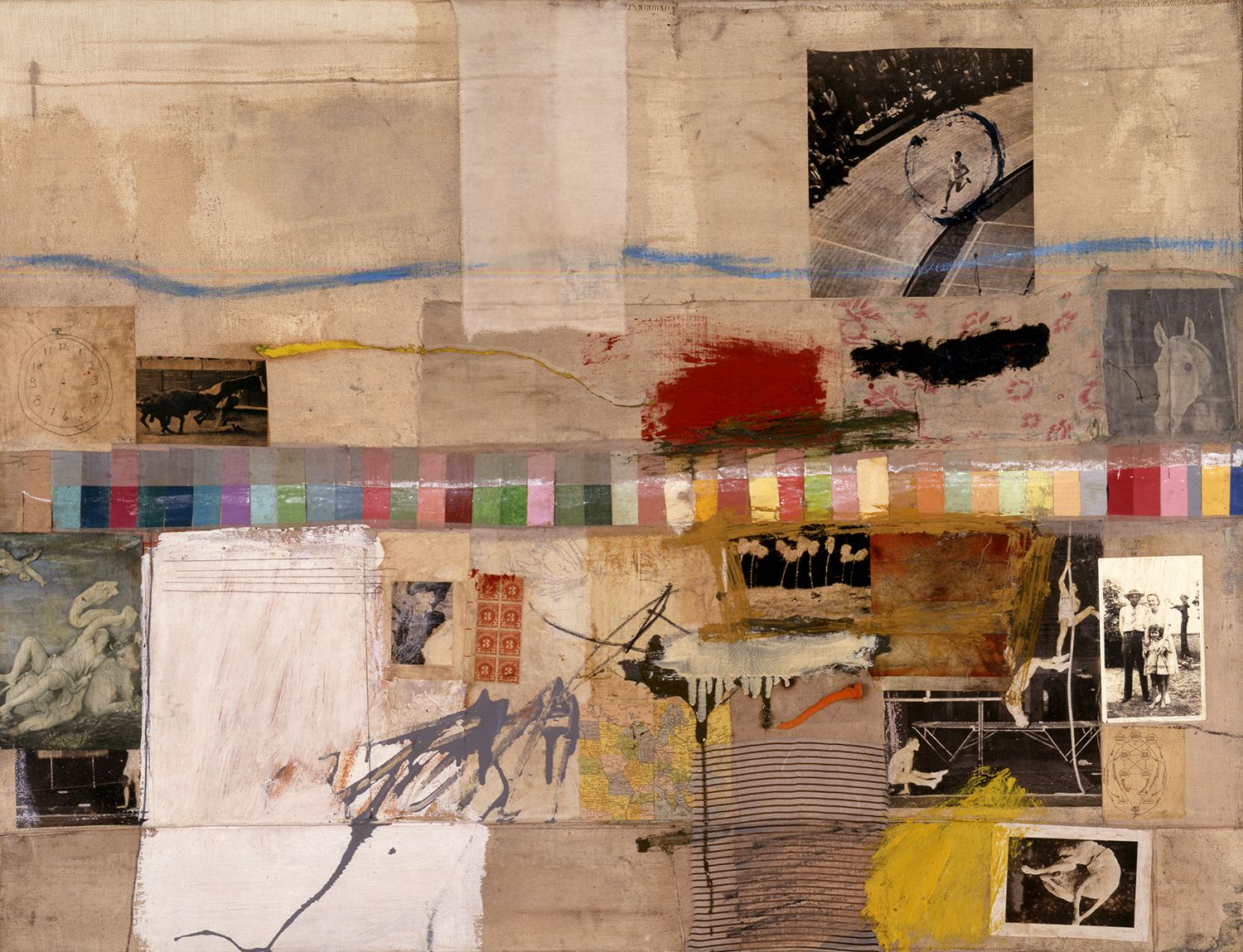 Robert RauschenbergSmall Rebus1956
- Image not availableRobert RauschenbergL.A. Uncovered #81998
- Image not availableRobert RauschenbergL.A. Uncovered #91998
- Image not availableRobert RauschenbergWaterworks Series - Celebration1993
- Image not availableRobert RauschenbergUntitled1982
- Image not availableRobert RauschenbergCloister Series1980
- Image not availableRobert RauschenbergSketch for Monogram1973
- Image not availableRobert RauschenbergThe Quarry1968
- Image not availableRobert RauschenbergKar1959-1960
- Image not availableRobert RauschenbergXXXIV Drawings for Dante’s Inferno1959-1960
- Image not availableRobert RauschenbergXXXIV Drawings for Dante’s Inferno1959-1960
- Image not availableRobert RauschenbergXXXIV Drawings for Dante’s Inferno1959-1960
- Image not availableRobert RauschenbergXXXIV Drawings for Dante’s Inferno1959-1960
- Image not availableRobert RauschenbergXXXIV Drawings for Dante’s Inferno1959-1960
- Image not availableRobert RauschenbergXXXIV Drawings for Dante’s Inferno1959-1960
- Image not availableRobert RauschenbergXXXIV Drawings for Dante’s Inferno1959-1960
- Image not availableRobert RauschenbergXXXIV Drawings for Dante’s Inferno1959-1960
- Image not availableRobert RauschenbergXXXIV Drawings for Dante’s Inferno1959-1960
- Image not availableRobert RauschenbergXXXIV Drawings for Dante’s Inferno1959-1960
- Image not availableRobert RauschenbergXXXIV Drawings for Dante’s Inferno1959-1960
- Image not availableRobert RauschenbergXXXIV Drawings for Dante’s Inferno1959-1960
- Image not availableRobert RauschenbergXXXIV Drawings for Dante’s Inferno1959-1960
- Image not availableRobert RauschenbergXXXIV Drawings for Dante’s Inferno1959-1960
- Image not availableRobert RauschenbergXXXIV Drawings for Dante’s Inferno1959-1960
- Image not availableRobert RauschenbergXXXIV Drawings for Dante’s Inferno1959-1960
- Image not availableRobert RauschenbergXXXIV Drawings for Dante’s Inferno1959-1960
- Image not availableRobert RauschenbergXXXIV Drawings for Dante’s Inferno1959-1960
- Image not availableRobert RauschenbergXXXIV Drawings for Dante’s Inferno1959-1960
- Image not availableRobert RauschenbergXXXIV Drawings for Dante’s Inferno1959-1960
- Image not availableRobert RauschenbergXXXIV Drawings for Dante’s Inferno1959-1960
- Image not availableRobert RauschenbergXXXIV Drawings for Dante’s Inferno1959-1960
- Image not availableRobert RauschenbergXXXIV Drawings for Dante’s Inferno1959-1960
- Image not availableRobert RauschenbergXXXIV Drawings for Dante’s Inferno1959-1960
- Image not availableRobert RauschenbergXXXIV Drawings for Dante’s Inferno1959-1960
- Image not availableRobert RauschenbergXXXIV Drawings for Dante’s Inferno1959-1960
- Image not availableRobert RauschenbergXXXIV Drawings for Dante’s Inferno1959-1960
- Image not availableRobert RauschenbergXXXIV Drawings for Dante’s Inferno1959-1960
- Image not availableRobert RauschenbergXXXIV Drawings for Dante’s Inferno1959-1960
- Image not availableRobert RauschenbergXXXIV Drawings for Dante’s Inferno1959-1960
- Image not availableRobert RauschenbergXXXIV Drawings for Dante’s Inferno1959-1960