This day-long symposium will gather esteemed musicologists, historians, composers and musicians to explore the life and musical legacy of Isang Yun (1917-1995), a pivotal figure in the history of avant-garde classical music. Born in Korea, Yun emigrated to Germany in the late 1950s and lived in Berlin until his death. His music synthesizes his diasporic perspective; merging Western academic training with traditional Korean music techniques, as well as ancient Korean iconography and mythologies. Yun’s unique artistic voice developed through a life marked by some of the major political events of the 20th century, including the Japanese colonization of Korea, the Korean War, and the political turmoil of the Cold War, which led to his exile from South Korea in the 1960s, following a period of imprisonment.
Attendees may join any or all sections, and are encouraged toRSVP.
This symposium is organized in partnership with artist Haegue Yang. Celebrated for her unique abstract visual language accompanied by choreographies of sensory experience, Yang has spent over a decade engaging with Isang Yun’s legacy through extensive archival and artistic research.
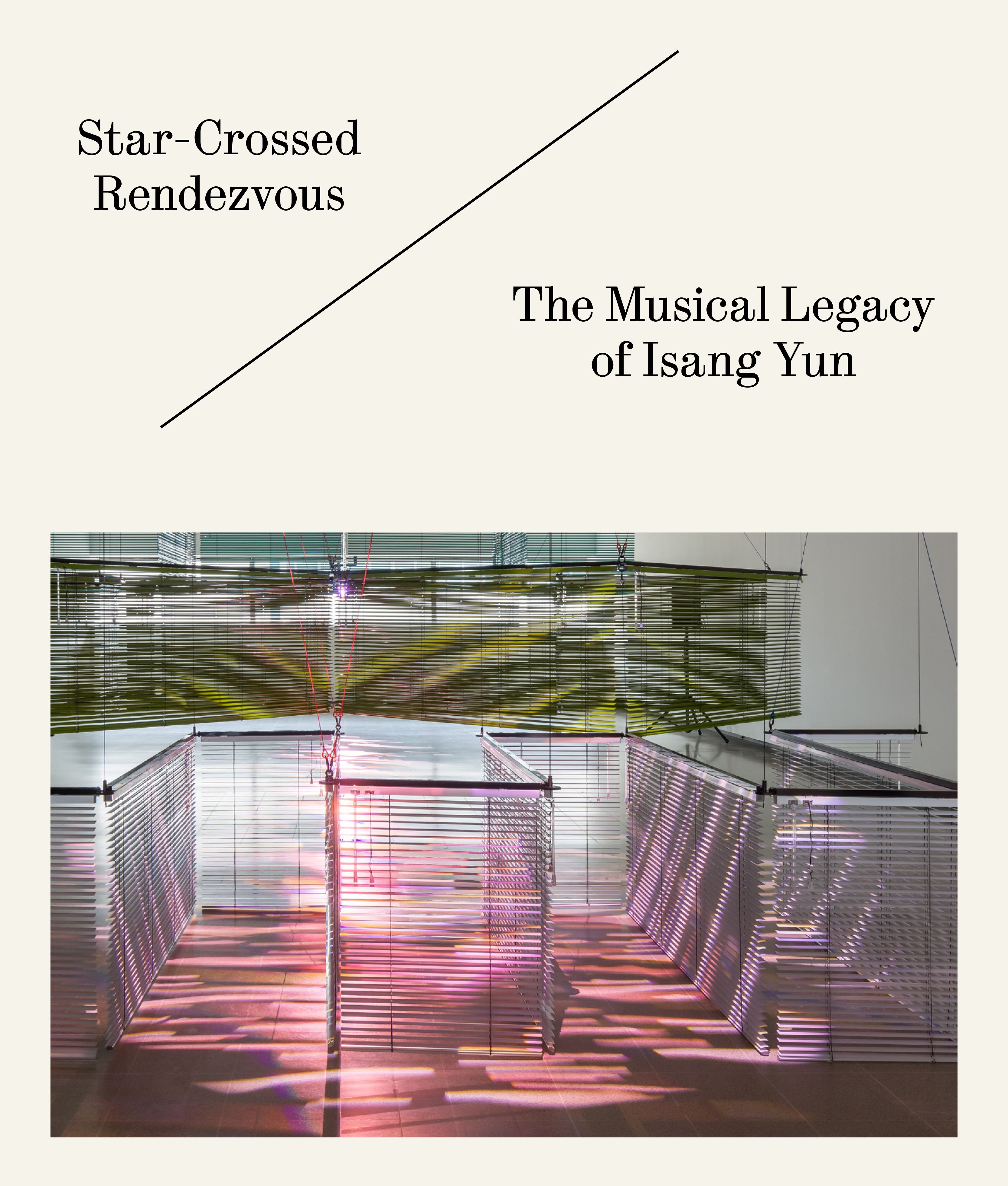
In March 2026, MOCA and the Los Angeles Philharmonic will collaborate to present Yang’s multi-sensorial installationStar-Crossed Rendezvous after Yun,2024 at MOCA and a concert of Isang Yun’sDouble Concerto,1977 at Walt Disney Concert Hall.
This program was co-organized by artist Haegue Yang; Clara Kim, Chief Curator and Director of Curatorial Affairs; and Paula Kroll, Assistant Curator, with Michele Huizar, Performance Coordinator, The Museum of Contemporary Art, Los Angeles.
Support is provided by Ministry of Culture, Sports & Tourism of Korea, Korea Arts Management Service, and Korea Focus Support Program.
Schedule
11am:Introduction by Clara Kim and Haegue Yang, artist
11:30am–12:30pm:Keynote presentations by Ryan Dohoney and Mina Lee
2pm:A recorded tribute to Isang Yun by Heinz Holliger
2:15–3:15pm:Performances by Musicians from the Colburn School
Isang Yun,Königliches Themafor solo violin (1976)
Performed by violinist Amelia Sze
Isang Yun,Contemplationfor two violas (1988)
Performed by violists Lan Cao and Rang Tae
Isang Yun,Glisséesfor cello (1970)
Performed by Jakob Taylor, cello
Isang Yun, Images for flute, oboe, violin and cello(1968)
Performed by Eric Bergemen, flute; Jini Baik, oboe; Whitney Takata, violin; Serge Kalinovsky, cello; and Philip Vitkov, Conductor
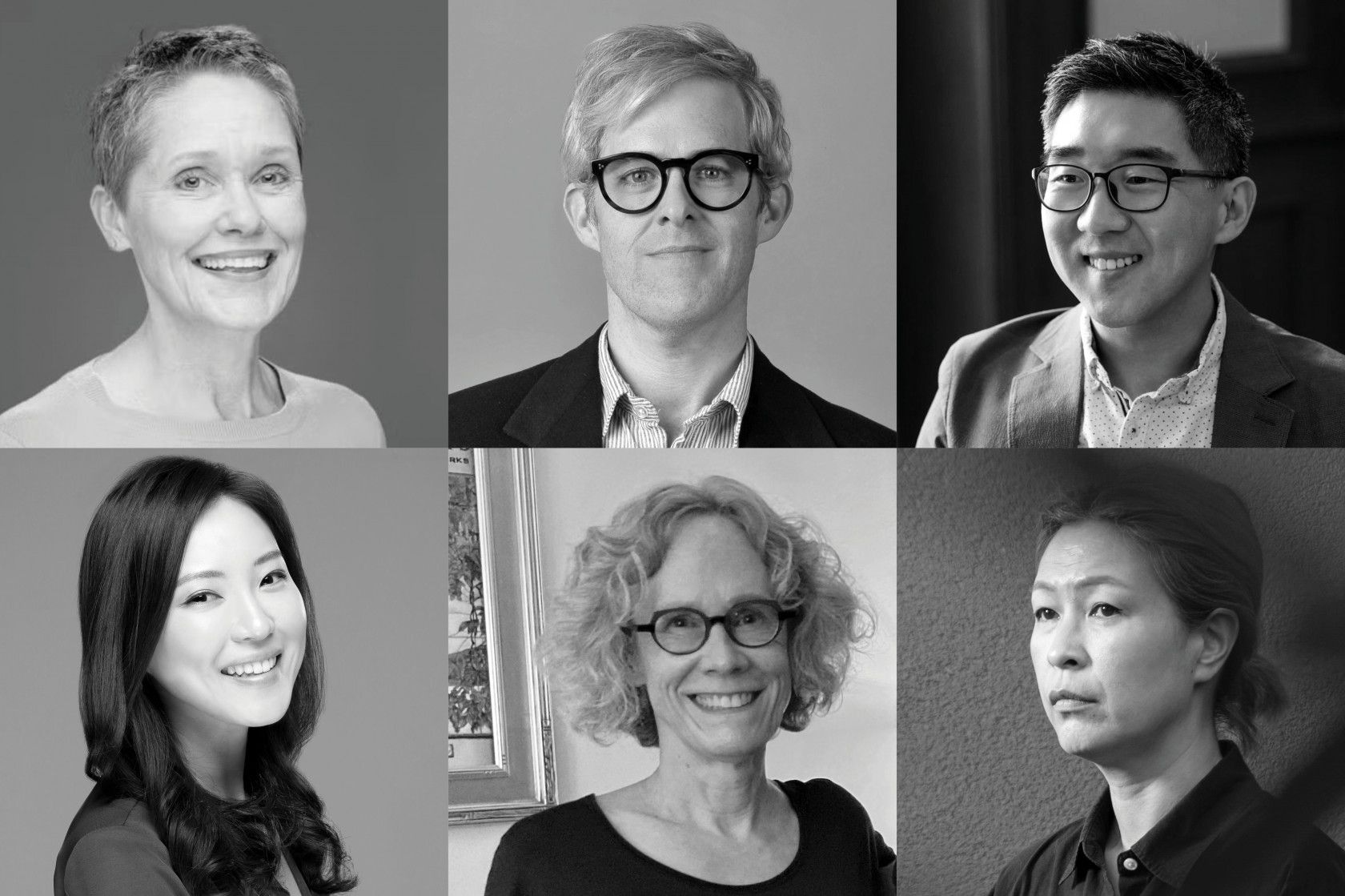
3:30–5 pm:Panel Discussion with Ryan Dohoney, Texu Kim, Mina Lee, and Anne C. Shreffler, moderated by Joy Calico
Speaker Biographies
Joy H. Calicois Professor of Musicology and chair of the Department of Musicology at UCLA's Herb Alpert School of Music. She is primarily interested in interdisciplinary questions of Cold War cultural politics, opera since 1900, and Arnold Schoenberg. She is the author ofBrecht at the OperaandArnold Schoenberg's 'A Survivor from Warsaw' in Postwar Europe, both published by University of California Press, and co-editor with Daniel Chua of the California Studies in Global Musicology book series. Calico is a member of the Villa Aurora Thomas Mann Haus Advisory Council, and has served on its composition jury.
Ryan Dohoneyis a scholar of U.S. and European modernism and experimentalism in the twentieth and twenty-first centuries. His research documents the aesthetic and emotional relationships produced by musical performance and artistic collaboration within interdisciplinary artistic communities. He serves as Professor of Musicology and Associate Dean for Faculty in the Bienen School of Music at Northwestern University. There he is also core faculty in the programs in Critical Theory and Comparative Literary Studies.
He received his PhD from Columbia University under the supervision of George E. Lewis. He received his Bachelor of Music in voice and music history at Rice University. He is the author ofSaving Abstraction: Morton Feldman, the de Menils, and the Rothko Chapel(Oxford 2019) andMorton Feldman: Friendship and Mourning in the New York Avant-Garde(Bloomsbury Academic 2022). His research has been supported by fellowships and grants from the American Council of Learned Societies, the American Philosophical Society, the Paul Sacher Foundation, and the Kaplan Institute for the Humanities. He is also a vocalist working closely with the Wandelweiser experimental music collective.
Texu Kim (김택수)transforms unconventional sources — from everyday encounters to overlooked human stories — into sophisticated, culturally grounded works infused with clarity, wit, and nuance. His music has been performed by the New York Philharmonic, LA Phil, San Francisco Symphony, San Francisco Opera, Seoul Philharmonic, and Ensemble Modern, and presented at the Tongyeong International Music Festival, among others. Winner of the 2021 Barlow Prize, he has also earned honors from the Fromm Foundation, Civitella Ranieri Foundation, and Isang Yun Foundation. He has served as Composer-in-Residence of the Korean National Symphony Orchestra and is an associate professor at San Diego State University.
Jung-Min “Mina” Lee, a native of Seoul, is a musicologist specializing in 20th- and 21st-century music with a focus on Korean and East Asian composers and the Darmstadt avant-garde. Her research explores how music travels across borders through performers, institutions, and ideas, drawing on postcolonial and globalization studies. She has written on topics ranging from the politics of musical life in Korea and the stylistic history of K-pop to artificial intelligence and composition. Her work has appeared in journals and edited volumes, including Twentieth-Century Music, Music and Politics, The Cambridge Companion to K-pop, and Digital Revolution and Music (in Korean). Her first monograph,Creating a Korean Avant-Garde: Music and Diaspora from Isang Yun to Unsuk Chin(under contract with Cambridge University Press), examines five composers whose careers, shaped by diasporic trajectories and transnational networks, transformed the course of modern music in Korea. Her research has been supported by the Academy of Korean Studies and the Association for Asian Studies, among others. In addition to presenting at major U.S. and international conferences, she has reached public audiences through program notes for orchestras and ensembles nationwide. She is currently professor of music history at The Juilliard School in New York City.
Anne C. Shreffleris interested in how music history is written (and rewritten), with special emphasis on the political and ideological associations of music, institutions of new music, women creators, and global musicology. She has published on the musical avant-garde in Europe and America, historiography, composers in emigration, performance theory, and contemporary opera, as well as on the music of Anton Webern, Igor Stravinsky, Elliott Carter, John Corigliano, Bruno Maderna, and Younghi Pagh-Paan. She is currently working on a book,A Very Short Introduction to New Music(Oxford University Press).
A proud 1975 graduate of the High School for Performing and Visual Arts in Houston, TX, Shreffler studied flute and music theory at New England Conservatory and received her Ph.D. in musicology from Harvard in 1989. She then taught at the University of Chicago and, from 1994 until 2003, University of Basel in Switzerland. She has taught at Harvard since the fall of 2003, where she is the James Edward Ditson Professor of Music and an Affiliate of the Department of Germanic Languages and Literatures.
Haegue Yang(b. 1971, Seoul) seeks to communicate without language in a primordial and visual way: often complementing her vocabulary of visual abstraction with sensory experiences that include scent, sound, light and tactility. Combining industrial fabrication and folk craftsmanship, Yang explores the affective power of materials in destabilizing the distinction between the modern and pre-modern. Yang’s unique visual language extends across various media (from paper collage to staging projects and performative sculptures), and materials (Venetian blinds, clothing racks, synthetic straw, bells and graph paper) that are torn, lacquered, woven, lit and hung. Her artistic explorations stem from material-based concerns and evolve to span philosophical, political and emotionally charged readings of historical events and figures.
Her ongoing research is empowered by underlying references to art history, literature and political history, through which she re-interprets some of her recurrent themes: migration, postcolonial diasporas, enforced exile and social mobility. As a result, these pieces link various geopolitical contexts and histories in an attempt to understand and comment on our own time. Yang’s translation from the political and historical into the formal and abstract, demonstrates her conviction that historical narratives can be made comprehensible without being linguistically explanatory or didactic.
Haegue Yang lives and works in Berlin and Seoul.