MOCA Presents Julian Charrière: Deep End, an Inaugural Eric and Wendy Schmidt Environment and Art Prize Exhibition
November 15, 2026–June 6, 2027
MOCA Grand Avenue
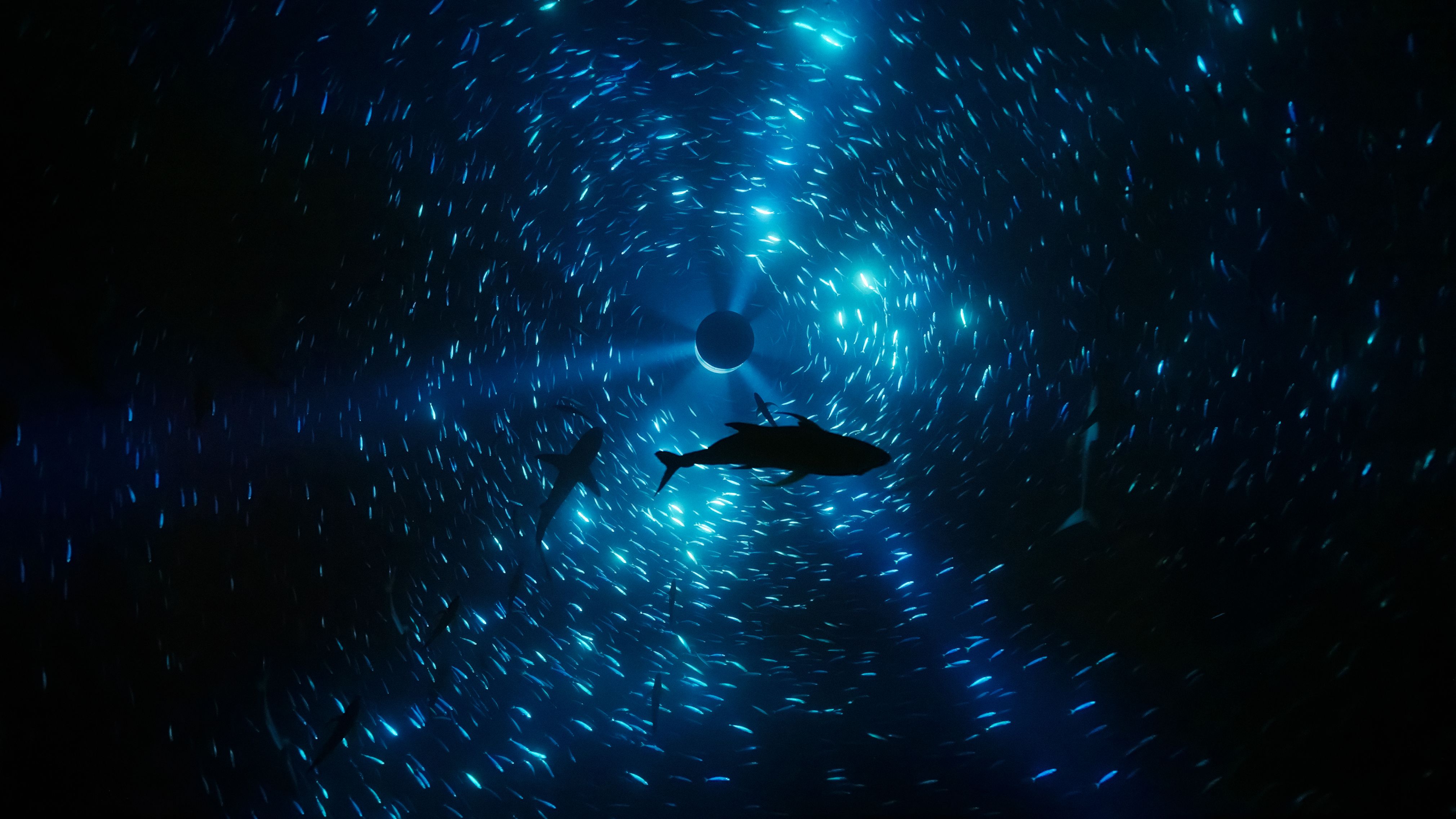
Julian Charrière, Midnight Zone (still), 2024, 4K video, 16:10 aspect ratio, 3D ambisonic soundscape, 56 min., continuous video loop © 2025 ProLitteris, Zürich; Copyright the artist.
LOS ANGELES—The Museum of Contemporary Art (MOCA) proudly presents Julian Charrière: Deep End, the French-Swiss artist’s first solo museum show in Los Angeles. One of two inaugural Eric and Wendy Schmidt Environment and Art Prize exhibitions presented at MOCA Grand Avenue this fall, Julian Charrière: Deep End is on view from November 15, 2026, through June 6, 2027 alongside Cecilia Vicuña’s Quipu of Encounters: The Dream of Water. Together, they reflect the Prize’s commitment to artists working at the intersections of art, climate, and environmental justice.
From early works in photography and sculpture to films and newly commissioned immersive installations, Deep End demonstrates Charrière’s more than a decade-long engagement with the aesthetic and political dimensions of the natural world, considering how geological time, human history and reparative futures interrelate. Charrière has worked across the globe, engaging with sites where natural forces and human actions converge, foregrounding the realities of rapid industrialisation, extraction and pollution, along with other urgent issues at the forefront of conversations surrounding climate resilience today.
The works on view in Deep End explore the fragility and resilience of planetary water systems, engaging with the complexity of the sea not only as a regenerative carbon sink, habitat, chemical marker for climate change or liminal space, but also as a vast biogeological system in which we are entrenched. Presented therein are immersive environments and atmospheric conditions that evoke the ocean’s abyss, including a darkened exhibition space where multi-sensory experiences create a porous relationship between the viewer and object. Dreamlike compositions of moving image and sound bring audiences on a visceral journey into some of the planet’s most vulnerable and remote ecosystems, encouraging careful listening to the constant communication between the organisms that occupy it. Materials such as bitumen, ground coral, and mud from the deep seafloor are embedded in several works, becoming charged with human history and our impulse to transform the natural world into a resource. They mark an intersection between the accelerating consequences of anthropogenic environmental change and the slow geological time required to produce the carbon deposits that fuel it.
The central component of the show is the new commission Hope Line (2026), which features a live stream of a coral reef near Port Antonio, Jamaica, strongly affected by the 2023 El Niño bleaching event. This meditative installation allows visitors not only to witness and listen to one of the most important and biodiverse habitat types on the planet, but also to emit their own voices into it. Bridging time and place, Hope Line ultimately asks how art can act as a vector for advocacy, marking an extension to Charrière’s Calls for Action (2024-ongoing) series, which, created in collaboration with Art into Acres and Re:Wild, invites museum audiences to commune with terrestrial rainforests around the world. The exhibition also facilitates the beginning of a feasibility study for a new but closely related project titled Reefwards – an enterprise which combines underwater land art with coral reef restoration and conservation, developed through past and present collaboration with scientists, researchers, NGOs and advising universities, and most recently in close dialogue with marine biologist and coral specialist Dr. Sebastian Schmidt-Roach and parametric designer and architect Phillipp Mecke.
Clara Kim, Chief Curator & Director of Curatorial Affairs at MOCA said: “Over more than a decade, Julian Charrière has developed a distinctive practice that combines rigorous fieldwork and scientific inquiry and which brings the ocean’s immense scale and precarity into sharp focus. Deep End embodies the ambition of the Eric and Wendy Schmidt Environment and Art Prize, providing artists with meaningful support to create new work that brings art into conversation with climate, ecology, and environmental justice. This new initiative made possible through the generosity of Eric and Wendy Schmidt reflects MOCA’s broader commitment to environmental sustainability and advancing urgent dialogue through our artistic program.”
The exhibition also marks the US premiere for Midnight Zone (2024/2025), Charrière’s film and installation that plunges viewers downward into the waters of the Pacific Ocean directly above the Clarion-Clipperton Fracture, an area between Hawaii and Mexico whose seabed is rich in polymetallic nodules that have become a target for deep-sea mining. A Fresnel lighthouse lens, traditionally used to aid navigation on the ocean’s surface, descends slowly into the sea, guiding viewers into the so-called ‘midnight zone,’ which while too deep for the rays of the sun to penetrate, is richly populated by fish, sharks, and countless other marine animals. In the galleries, a sculptural installation featuring the same Fresnel lighthouse lens conceived for this project will mirror the film, rotating within a custom-built structure and casting a ghostly light throughout the spaces.
Julian Charrière noted: “Art, for me, is about lingering on reality. It is not necessarily about changing anyone’s mind, but about creating spaces and encounters that allow us to see and feel anew; to re-attune our senses and values. Because attention is, in and of itself, political; it has a charge. It can be an act of reorientation, shifting how we think about being-in and -with the world. If an artwork can, even momentarily, alter our relationship to a landscape, be it an ocean zone, or a glacier, or a reef, then it can perhaps also reshape how we understand our place alongside and within that environ, and the responsibilities and implications that come with it.”
Julian Charrière: Deep End is organized by Paula Kroll, Assistant Curator, The Museum of Contemporary Art, Los Angeles, in collaboration with Kelsey Shell, Environmental Strategist, The Museum of Contemporary Art, Los Angeles.
Assistant Curator Paula Kroll explains: “Deep End draws attention to the ways we perceive the ocean, deploying art as a tool for generating understanding and stewardship for marine environments. Developed in close collaboration with the artist, the exhibition brings together works from across his practice with an ambitious new commission shaped by the depth of knowledge of a group of advisors that includes marine scientists, researchers, designers, and coral-restoration partners. This collaborative process has been central to the exhibition, grounding its immersive experiences in actionable support for communities working directly to protect both the deep sea and vulnerable reef ecosystems across the world.”
Julian Charrière: Deep End will be accompanied by a richly illustrated exhibition catalogue published by MOCA in Spring 2027. The catalogue will feature the artist’s images and research related to the new commission Hope Line; an essay by Kroll and a conversation between Charrière and Kroll; and an essay by Elizabeth DeLoughrey, Professor in the English Department and the Institute of the Environment and Sustainability at UCLA.