The Temporary Contemporary
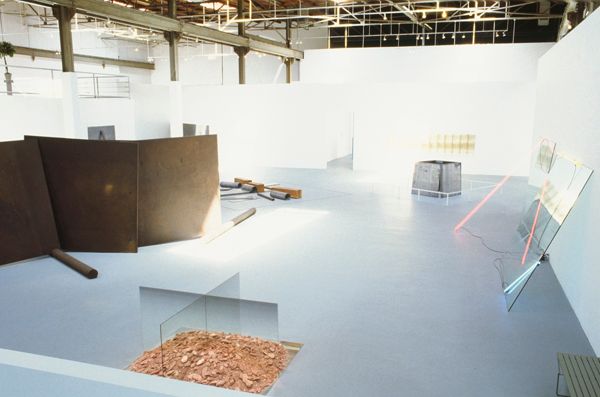
The New Sculpture 1965-75: Between Geometry and Gesture charted a volatile but enormously influential period in American art. Shortly after the explosion of Pop and Minimalism in the early 1960s, artists in The New Sculpture explored novel aesthetic possibilities afforded by these movements while exceeding either category on its own. Merging simplified Minimalist sculptural forms with the whimsy and irony of Pop, the works in the show—variously labeled “Post-Minimal,” “Process Art,” or “Anti-Form” in historical accounts—used chance or environmental factors to create irregular, non-geometrical structures and shapes, such as Lynda Benglis’s Quartered Meteor (1969/1975), a lead corner piece resembling molten rock. These experiments in material and process defined a new artistic lexicon that would continue to be used by makers decades in the future. The ten featured artists included Eva Hesse, Robert Smithson, Richard Tuttle, Bruce Nauman, Richard Serra, Barry Le Va, Alan Saret, Keith Sonnier, Lynda Benglis, and Joel Shapiro.
The exhibition was accompanied by a catalogue published by the Whitney Museum of American Art, New York.
The New Sculpture 1965-75: Between Geometry and Gesture was organized by Richard Armstrong and Richard Marshall for the Whitney Museum of American Art, New York and by Paul Schimmel, Chief Curator, and Elizabeth T. Smith, Curator, for The Museum of Contemporary Art, Los Angeles.
The Temporary Contemporary is the original name of The Geffen Contemporary at MOCA.