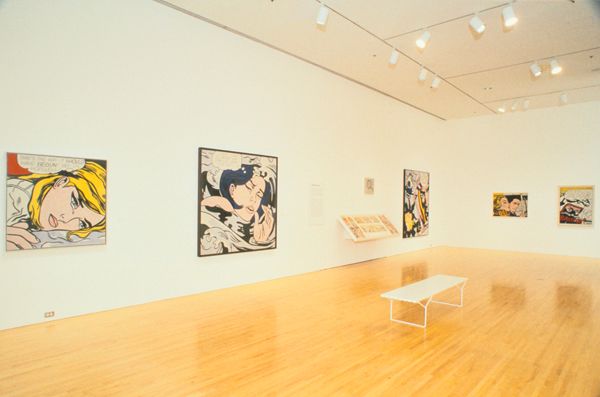
High and Low: Modern Art and Popular Culture examined the relationship between 20th-century Western art and mass media imagery. The traveling exhibition juxtaposed over two hundred and fifty works by fifty major artists with source imagery from newspapers, billboards, sales catalogues, graffiti, comics, and more.
High and Low comprised four main sections, each highlighting a different popular media source or style. “Advertising” included Pablo Picasso, Fernand Léger, James Rosenquist, and other artists who appropriated imagery from billboards and the popular press; Aleksandr Rodchenko, who inversely used modernist aesthetics for Soviet ads; and Marcel Duchamp, Meret Oppenheim, and later artists like Jasper Johns, who used consumer products directly in their art. “Graffiti” identified the influence of this vernacular artistic style on Jean Dubuffet, Cy Twombly, and Robert Rauschenberg; “Caricature” retheorized the use of bodily distortion in Rene Magritte and Constantin Brancusi’s art. “Comic Strips and Comic Books” featured Roy Lichtenstein and Philip Guston and compared Joan Miró’s Nocturnes to George Herriman’s Krazy Kat cartoons. An unofficial final section highlighted contemporary artists Elizabeth Murray, Jeff Koons, and Jenny Holzer.
The exhibition was accompanied by a catalogue.
High and Low: Modern Art and Popular Culture was organized by Kirk Varnedoe, The Museum of Modern Art, New York, and Adam Gopnik, The New Yorker.