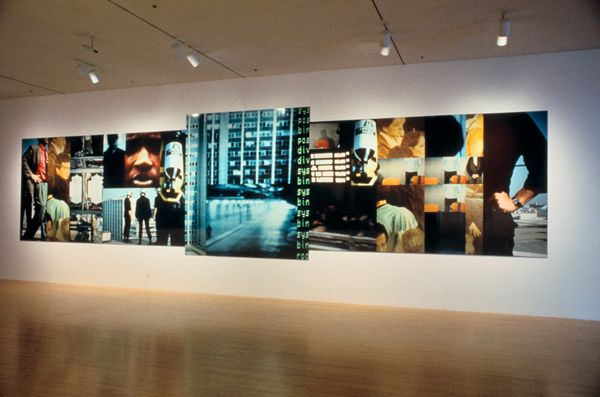
California-born artist Lewis Baltz was part of the “New Topographics” photography movement in the early 1970s with his formal, detached images of suburban industrial landscapes in the US. These minimalist, black-and-white photos were most often human-less, accentuating the banal new landscape of identical strip malls, industrial parks, and suburbs appearing across the US. In the late 1980s, Baltz moved to Europe, where he began producing panoramic cibachrome prints, three of which were presented for the first time in the US in Focus Series: Lewis Baltz.
Ronde de Nuit (1991–92), a thirty-five-foot long by six-foot-high installation of twelve prints, assembles various images related to the theme of surveillance. Docile Bodies (1994) examines the visual technologies of medical science with cropped photos from French hospitals. The Politics of Bacteria (1995) arranges pictures from in and around the Ministry of Finance in Paris-Bercy, creating a shape resembling an altarpiece. This trilogy of works belonged to Baltz’s series “new technologies.”
Focus Series: Lewis Baltz was part of the museum’s Focus Series (1992–1998), which was dedicated to presentations of distinct bodies of work by artists working in all media and featured a roster of distinguished local and international artists.