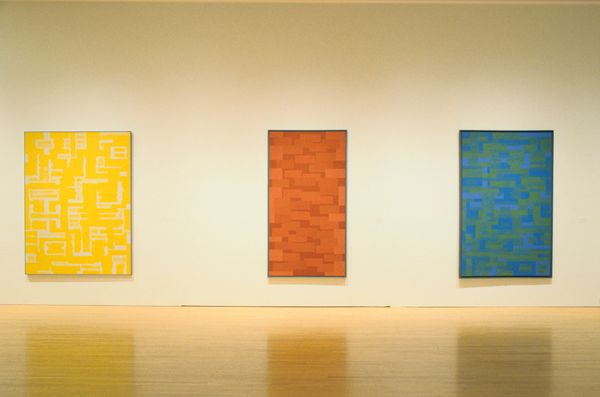
Ad Reinhardt constituted the first major museum retrospective and included approximately eighty paintings, gouaches, and collages spanning Reinhardt’s nearly four-decade-long career.
Reinhardt rose to prominence in 1940s New York alongside early Abstract Expressionists like Willem de Kooning and Jackson Pollock. Unlike his contemporaries, however, he eschewed expressivity and pursued an austere sense of “purity” in painting instead. The earliest works in the show date to the late 1930s and 1940s and reveal the artist’s early interest in geometric, Cubist, and Persian art. In the early 1950s, he began developing the “brick” and monochrome works for which he is better known—paintings of staggered, brick-like rectangles and paintings of seemingly flat color fields, respectively. Crucially, the latter works are embedded with subtle nuances that modulate the canvas’s response to environmental light. These perceptual investigations continued through the final grouping of the show, comprising Reinhardt’s famous Black Paintings. These iconoclastic works mixed black paint with traces of other hues to render barely perceptible surface forms.
The exhibition was accompanied by a catalogue.
Ad Reinhardt was co-organized by Richard Koshalek, Director, The Museum of Contemporary Art, Los Angeles, and William Rubin, Curator, the Museum of Modern Art, New York.