
The Pool Party of Sardanapalus (after Delacroix, Kienholz), 2017
- Medium
- Sumi ink and collage on paper
- Dimensions
- 125 1/2 × 140 in. (318.77 × 355.6 cm)
- Accession Number
- 2017.48
- Credit
The Museum of Contemporary Art, Los Angeles
Purchase with funds provided by the Acquisition and Collection Committee and Ari Emanuel
Walker’s The Pool Party of Sardanapalus (after Delacroix, Kienholz) uses the visual language of political cartoons but occupies the scale and ambition of 19th-century history painting. Its title and composition refer to French artist Eugène Delacroix’s massive 1827 painting The Death of Sardanapalus, which depicts a vanquished king who watches as his “possessions”—slaves, wives, horses, and treasures—are raped and plundered by his enemies. Walker, like Delacroix, presents a scene of diabolical destruction. The central triangular shape of Walker’s composition is formed by the lines of three ropes tethered to the foot of a white man, who is stripped naked, eviscerated, and pulled in three directions by three young black women in bathing suits. The group pointedly recalls a notorious 2015 incident in which a white police officer tackled and handcuffed an unarmed black teenage girl attending a private pool party in McKinney, Texas, and then drew his handgun on fellow partygoers (likewise unarmed); a grand jury declined to indict the officer involved. Walker’s roiling composition—whose characters belong to disparate historical periods (antebellum to the present day)—is punctuated by other moments of racial violence, cruelty, and suffering, as if to emphasize the persistence of violence perpetrated against black Americans from the era of slavery to police brutality in the 21st century.
 Kara WalkerUnmanned Drone2023
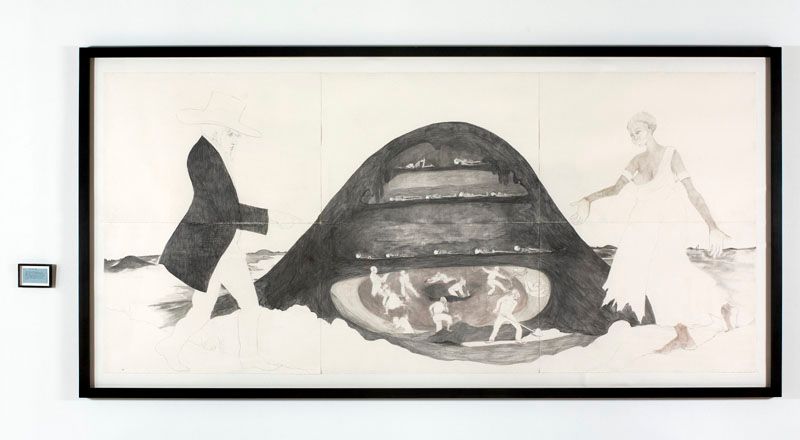 Kara WalkerAbout the title - I had wanted to title this “sketch after my Mississippi youth” or “the excavation” as I pictured it a sort of introduction to the panorama to come. However the image, which is partly borrowed, is of an Indian mount-painted by Mr. J. Egan in 1850 is meant to remind the dear viewer of another place altogether, from which we suckle life. Perhaps my rendering is too subtle...2002
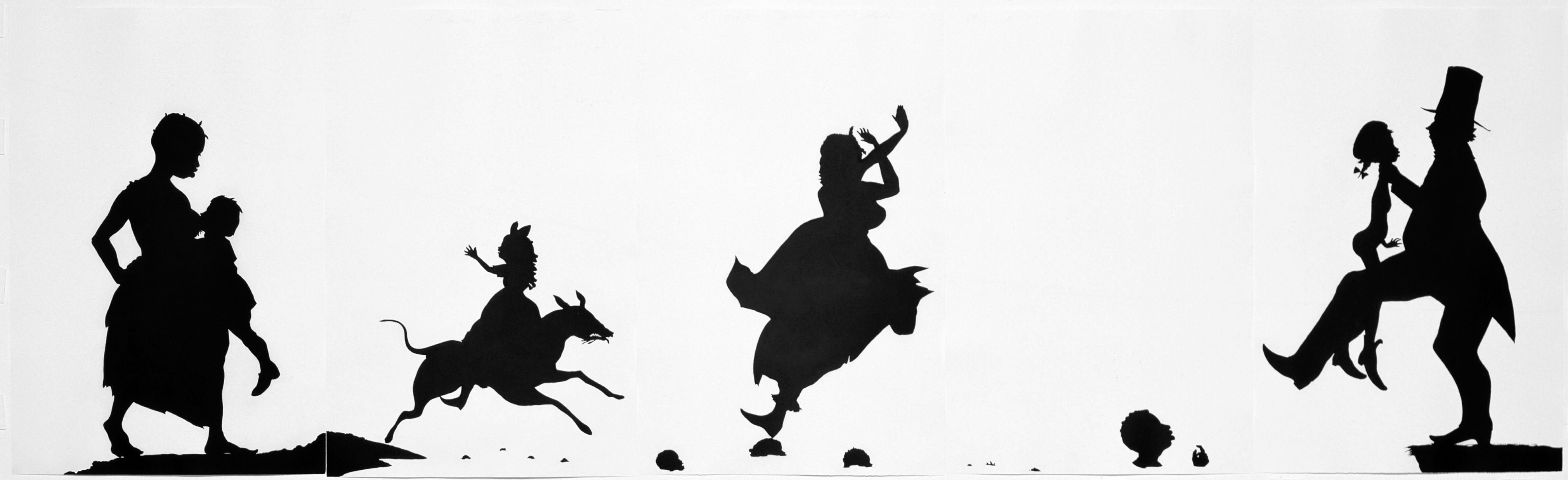 Kara WalkerThe Means to an End...A Shadow Drama in Five Acts1995