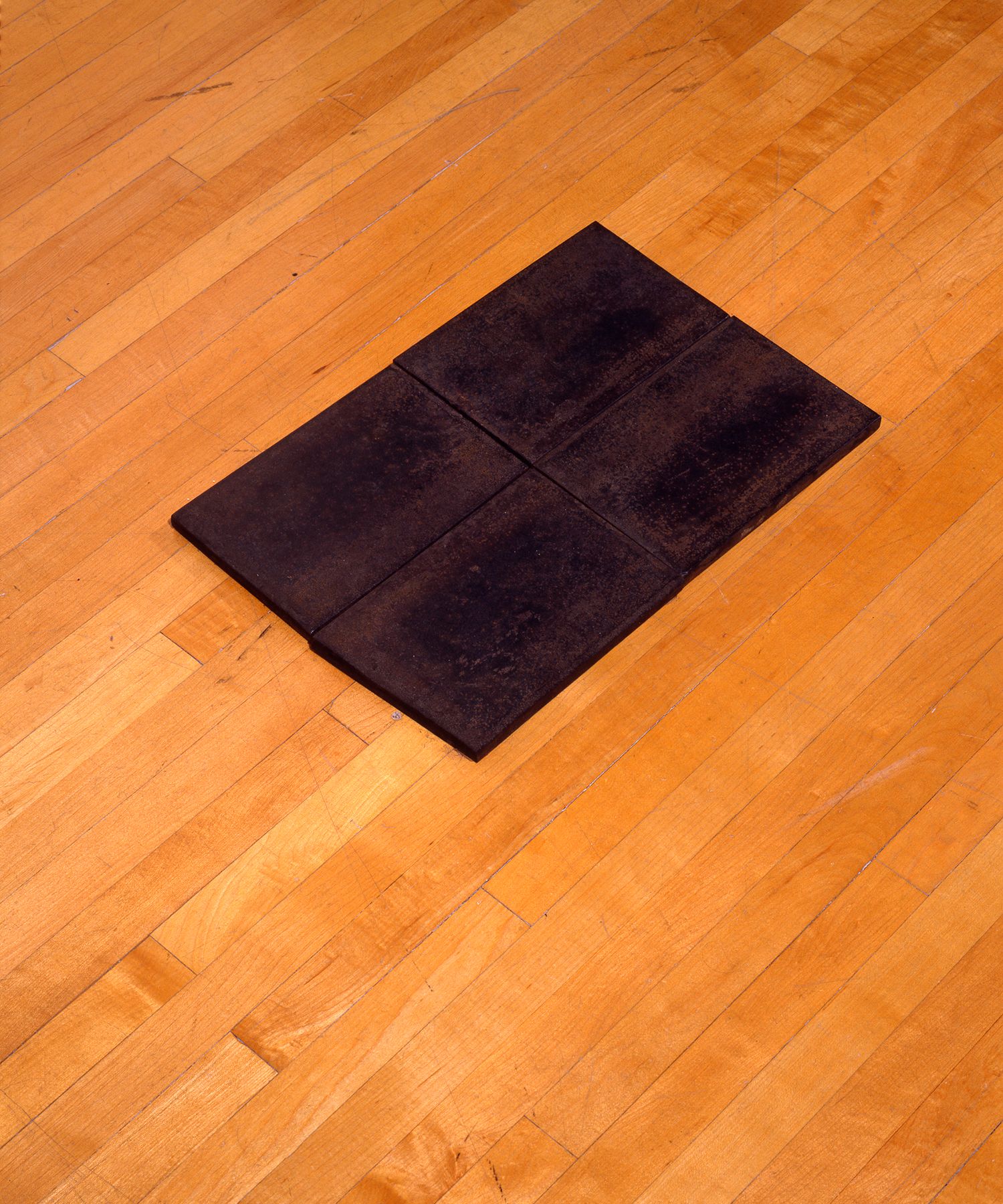
Steel-Zinc Dipole (E/W), 1989
- Medium
- Steel and zinc
- Dimensions
- 39 3/8 × 39 1/4 × 3/16 in. (100.01 × 99.7 × 0.48 cm) Each: 39 3/8 × 19 5/8 × 3/16 in. (100.01 × 49.85 × 0.48 cm)
- Accession Number
- 2000.1A-B
- Credit
The Museum of Contemporary Art, Los Angeles
Gift of Gilbert B. Friesen in honor of Jeremy Strick
One of the most significant aspects
of Carl Andre’sSteel-Zinc Dipole (E/W)is
that it has no pedestal. Because it occupies the same space as its viewers, this
sculpture behaves less like art
and more like an ordinary object in the world. Viewers
are even allowed to violate the museum’s hallowed rule “do not touch” and walk
on the sculpture. Traditionally, the pedestal helped to isolate art from the
viewer, making it seem separate or placing it in an autonomous realm.
But minimalist sculptors like Andre planted their work directly on the floor in
order to draw attention to the continuity between the artwork and the
surrounding space. By inviting viewers to make physical contact, to listen to
the sounds they make when stepping on plates of different densities, and to use
their own bodies as a measure of scale,
Andre shifts emphasis away from the centrality of art toward the
relationships between object, viewer, and gallery.
 Carl AndreAsterism1981
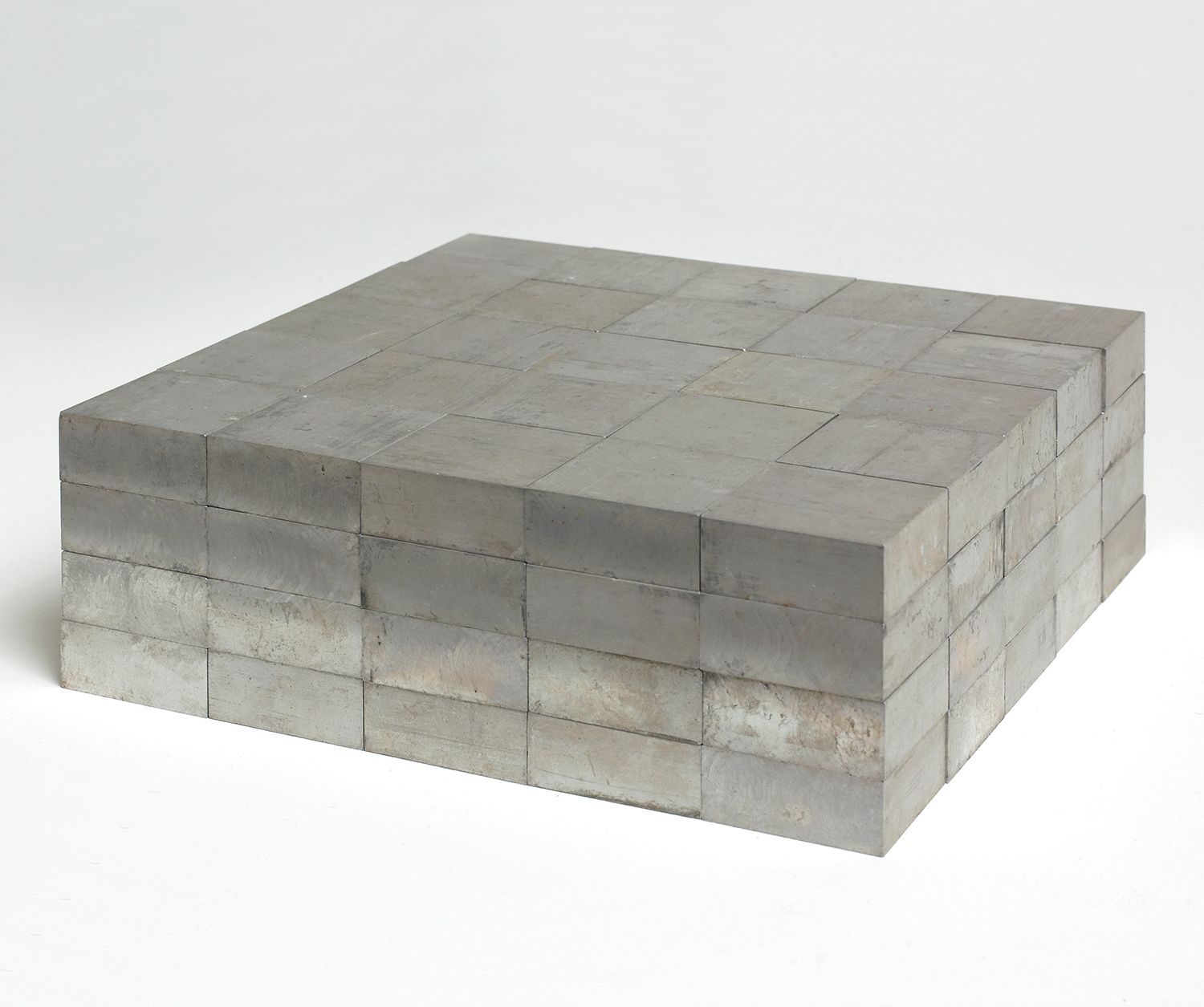 Carl Andre100 Aluminum Solid1964
- Image not availableCarl AndreUntitledn.d.
- Image not availableCarl Andre8 Blocks and Stones1973
- Image not availableCarl AndreYucatan1973
- Image not availableCarl AndreSeven Books of Poetry: Three Operas, A Theory of Poetry, American Drill, Passport, One Hundred Sonnets, Lyrics and Odes, Shape and Structure1969-1970
- Image not availableCarl AndreLetter to Yvonne Rainer1967