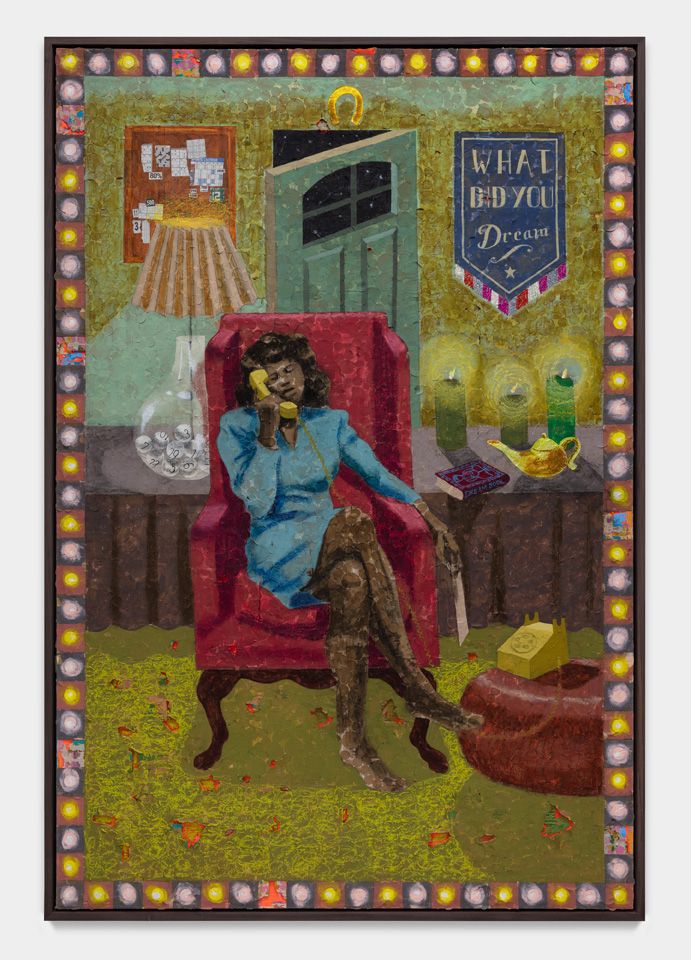
Seven Eighty-eight, 2022
- Medium
- Acrylic, charcoal, cardboard, oil pastel, and foil on newspapr mounted on canvas
- Dimensions
- 92 1/2 × 62 3/4 in. (234.95 × 159.39 cm)
- Accession Number
- 2022.29
- Credit
The Museum of Contemporary Art, Los Angeles
Gift of Pete Scantland
Derek Fordjour (b. 1974 Memphis, Tennessee) is an artist based in New York who grapples with the politics of access and representation, specifically in relation to race, through large, highly-textured paintings on newsprint that portray Black subjects engaged in various modes of American performance,
such as college athletics and musical processions.
A student of Nari Ward at CUNY, Hunter, Fordjour works purposefully with accessible materials, building up his canvas with layers of cardboard and painted newspaper, which he then excavates when creating his compositions. He favors utilizing the Financial Times as a medium, attracted to the paper’s distinct salmon color (which lends warm tones to his paint), as well as its odd duality as a widely accessible publication produced for a white, affluent demographic.
In producing work with ubiquitous materials that feature often jubilant, Black subjects, Fordjour seeks to increase art’s accessibility beyond a privileged demographic while filling in the gaps of representation in art history. Yet Fordjour’s signature style causes the joy emanating from his canvases to ripple with uncertainty; the collaged surfaces appear to shimmer, never fully concrete, obviating the nature of painting, and equality, as an illusion.
Seven Eighty-eight depicts a woman reclining in an armchair holding a yellow rotary telephone to her ear. She is surrounded by symbols of superstition, mysticism, and fortune telling, including a tapestry on the right that reads “What Did You Dream;” a genie lamp on the table next to her; and a bulletin board posted with clippings of Sudoku puzzles, a sports calendar, and various decontextualized numbers. Indeed, there are multiple instances of numbers appearing throughout the composition, such as a lamp sitting in a vase of Bingo balls, and the work’s title, Seven Eighty-eight, which potentially references the biblical verse of Numbers, 7:88, a passage providing inventory of the animals slaughtered at the altar during Moses’s dedication of the Tabernacle. The painting appears to glow, contained by a pattern
reminiscent of twinkling bulbs, like those which might frame a late-night psychic’s storefront, clinching the entire scene as a collage of clichéd mysticism. While her environment overwhelmingly suggests she is a psychic, the woman appears strange as if removed from her original context, donning a blue frock indicative of an office profession rather than a fortune teller’s parlor. Her bare feet indicate both comfort in her surroundings and fatigue from hard work, as if she has kicked off her pumps for the remainder of her night shift. Her professional appearance grounds the composition, declaring the mystic field as her livelihood, her method of survival.