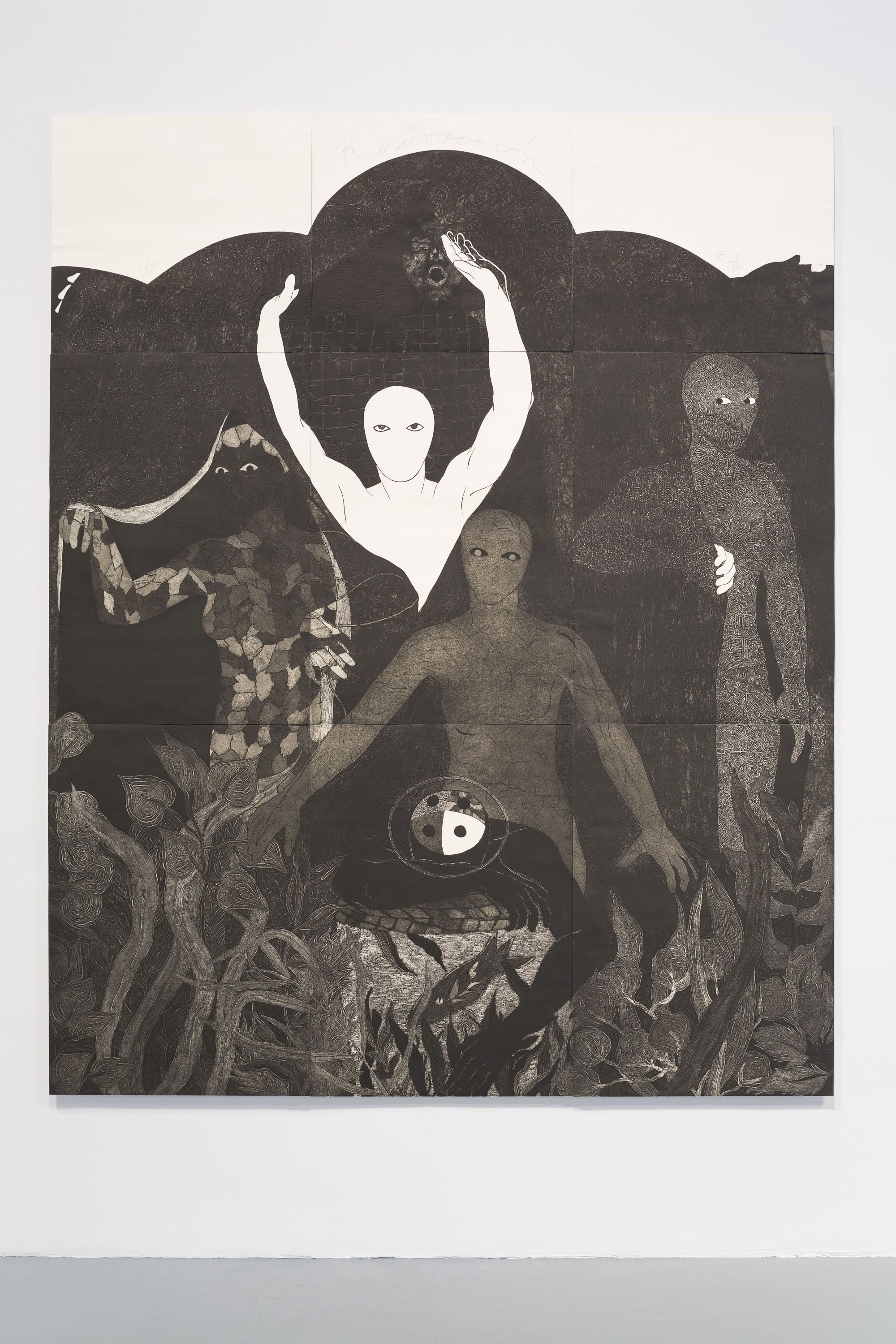
Resurección, 1998
- Medium
- Collography on paper
- Dimensions
- 9 parts: 106 x 85 in. (269.2 x 215.9 cm) Each (Top Row): 26 x 28 1/4 in. (66.04 x 71.76 cm) Each (Center Row): 40 x 28 1/4 in. (101.6 x 71.76 cm) Each (Bottom Row): 40 x 28 1/4 in. (101.6 x 71.76 cm)
- Accession Number
- 98.34A-I
- Credit
The Museum of Contemporary Art, Los Angeles
Gift of the artist
Ayón came to prominence as an artist in the 1980s, a renaissance period of artistic production in Cuba that saw the emergence of “New Cuban Art” and the establishment of the Havana Biennial. Her signature form of printmaking was collography, a distinctive technique in which various materials are adhered to a rigid base, inked, and then imprinted on paper using a printing press to yield richly textured results. The principal subject of her collographs is Abakuá, a secret mutual aid society that, like Santería, is one of the major Afro-Cuban religions. Membership in the society is prohibited to women, and so for the artist and viewers alike, the prints allow clandestine access to this fraternal order, whose beliefs and rites are only known to initiates—their sworn secrecy is emphasized by the figures’ lack of mouths. Ayón also frequently included female figures, modeling them after herself and thereby adding another degree of access to or identification with the spiritual mystery of these scenes.