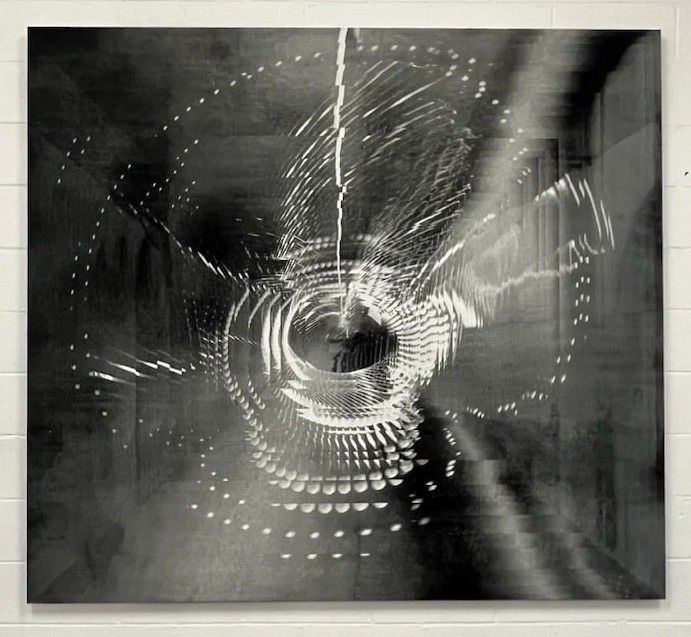
One to Two Seconds, 2024
- Medium
- Acrylic, flashe, and charcoal on canvas
- Dimensions
- 80 × 72 in. (203.2 × 182.88 cm)
- Accession Number
- 2025.24
- Copyright
Courtesy of the artist and Hannah Hoffman, Los Angeles.
- Credit
The Museum of Contemporary Art, Los Angeles
Purchase with funds provided by the Emerging Art Fund
Kate Mosher Hall (b. 1986, Los Angeles) is a LA-based painter whose work explores the tension between visibility and invisibility, abstraction and representation, and the ways in which images multiply, distort, and decay. Her practice engages both digital and analog techniques, layering silkscreen,
collage, and paint to construct compositions that challenge modes of looking. Hall has developed a lexicon for her paintings, categorizing them into groups such as "box paintings," "hole or mesh paintings," and "recursion paintings," among others. Across her work, Hall interrogates the conditions under which we encounter images—how they are mediated through screens, compressed, replicated, and flattened—while simultaneously creating paintings that resist easy reproduction. One to Two Seconds, a vortex-like composition in which an indiscernible image appears to spiral and collapse inward on itself, exemplifies Hall’s “recursion” paintings. These particular paintings are built through a meticulous process of layering silkscreened images atop one another, generating a sense of infinite depth to emphasize repetition, perspective, and an evolving relationship to images over time. The work is constructed through multiple passes of light-sensitive emulsion, silkscreen, and hand-
applied paint, a process that can involve anywhere from eight to thirty screens per painting. The black matte of the composition, which Hall considers essential to the work’s spatial logic, recedes into two-point perspective, creating the illusion of a void while also emphasizing the materiality of the painted surface. The recurrence of the same image—layered in slightly altered form—suggests the way images circulate in contemporary digital culture, where repetition, degradation, and reinterpretation are constant forces. Hall has likened this effect to a “deep-fried meme,” where an image is screenshotted and reshared to the point of abstraction. Up close, the painting’s individual layers and textures become apparent, but from a distance, it resolves into a singular, vertiginous field, resisting a fixed way of seeing.