
null

ABOUT TRADING DIRT


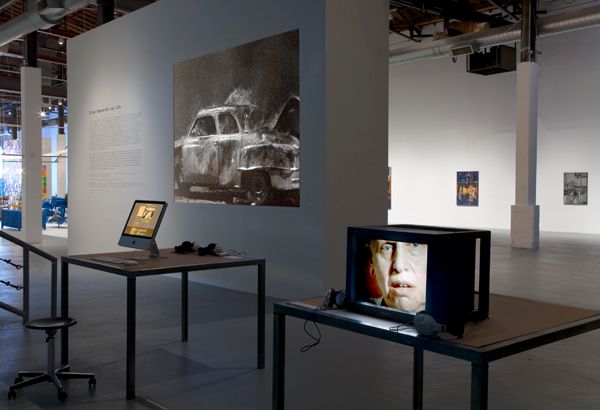
Trading Dirt (1983-86), an Allan Kaprow Happening as related by Kaprow during his retrospective PRECEDINGS at the Center for Research in Conempoary Art, University of Texas at Arlington, April 1988. Retrospective organized by Jeff Kelley.

Video by Peter Kirby.


Trading Dirt
By Jeff Kelley

One day in 1983 Kaprow woke up with the idea “to do an extended piece.” It occurred to him that it might be fun to trade buckets of dirt with unsuspecting, or somewhat suspicious, others. He would dig a buckets worth of dirt from his garden and place it, along with a shovel, in the back of his pickup truck. He would then ask a friend or acquaintance for a bucketful of dirt and offer his bucketful in return. Charmed by the idea, he dug the dirt (“it was good dirt; we’d been working that dirt”), put it in a bucket, put the bucket in the truck, and forgot about it for several months.

One night, as he was preparing to leave the Zen Center after several cross-legged hours on a pillow, he suddenly remembered the dirt (an earthly satori?). He asked one of the young men who lived there if he could have a bucketful of dirt. Taken aback, the fellow shrugged, pointed toward the plantings, and said, “Sure. You can have all the dirt you want.” Kaprow said thanks and went to his truck to get his bucket of garden dirt and the shovel. When he returned, the young man, having recovered from his incredulity, met him by saying, “Wait. I have a better idea. Instead of taking the dirt from around the plantings here, let’s go under the seat of our teacher. That way, it will be heavy-duty Buddhist dirt. It will have all the vibes of her ass.”

Crawl spaces under Southern California houses aren’t very roomy, and Kaprow had to scoot along on his belly with a flashlight, dragging his bucket of dirt and the shovel behind him as he brushed away cobwebs. The ground was hard and dry and laced with concrete rubble and nails from when the house had been built. As he struggled to find the spot beneath his teacher’s seat, he began having “some pretty uncharitable thoughts” about giving up good dirt for “this crap.” unable to locate the exact spot- “we wanted a direct beam from her ass to the ground”- Kaprow asked his friend to go back upstairs and knock on the floor where their teacher sat.

Once he found the spot, Kaprow realized his shovel was useless, since there was not enough room to stand it up. Improvising, he poured out his garden dirt and began scooping away at the ground with the empty bucket. With some effort, he got the bucket filled, set it aside, and pushed his good dirt- loamy and rich with nutrients- into the hole. The exchange was complete and fair. Although the dirt from under the Zen Center was dry and depleted, it was spiritually “vibrant” from prolonged exposure to “Buddhist vibes.’ presumably, the rich garden dirt would now acquire a less material nutrition, while the heavy-duty Buddhist dirt- that’s what Kaprow called it- would test its faith out in the material world.

Kaprow wiggled out from under the house, and as he dusted himself off several other Zen Center attendees who had gathered asked what he was doing. When he told them he was trading dirt, they asked why. When he told them, “That’s what I do,” someone said, “That’s stupid.” kaprow replied, “I suppose you think sitting on a cushion all day in and day out is smart.” Everyone laughed. “That was a flash, you see, about the meaning of life.”- it can only be discussed in particular, in terms of dirt, or stupidity or silliness, or childsplay. Kaprow and his friends talked for hours about the meaning of life and drank beer from a cooler in someone’s truck. They all knew that a profound, if silly, exchange had taken place. They also knew they wouldn’t have been discussing it if the metaphors of that exchange had been religious or philosophical. A bit drunk, they all went their separate ways, and Kaprow put the bucket and shovel back in his truck, where he again forgot about them.

Several months later, he chanced upon his friend Eleanor Antin, who was also then attending the Zen Center. She said, “I hear you’re trading Buddhist dirt.” Kaprow told her the story of the earthy exchange beneath the teacher’s seat, then asked, “Hey, can I have a bucket of your dirt?” Antin, familiar with these kinds of involvement, said, “Sure. You’re up to your old tricks.” He followed her up a weathered dirt road to her house on a dusty hilltop outside Del Mar. when they arrived, Antin asked Kaprow to wait because she wanted to talk to David, her husband, about making the trade “together with him.” Shortly, they emerged from the house, “looking rather pensive,” and announced to kaprow that they wanted to dig the dirt themselves and that they has “chosen the grave of their dog,” Hayden, who was buried in the garden. “That’s very… touching,” Kaprow offered. David and Eleanor, “already teary-eyed,” dug soil form the grave and, after pouring the heavy-duty Buddhist dirt into the hole, handed him a bucket full of Hayden. He put it in the back of his truck and drove down the hill.

One day later that spring, while he was buying fruits and vegetables at a farm stand near his home, Kaprow remembered the dirt. The woman who owned the farm stand knew him as a customer and, vaguely, as an art professor at UCSD. When Kaprow asked her, out of the blue, if he could have a bucket of dirt, quickly offering one of his own in return, she seemed confused by the question. She stared, at Kaprow as it trying to figure out if the question was for real or just a joke. “You want a bucket of sir? From around here? For what?” Maybe she thought she hadn’t heard him right. Seeing her perplexity, Kaprow began telling the sour of the previous exchanges. “Listen, this is dir from the grave of a dog of a friend of mine, which I treaded for a bucket of heavy-duty Buddhist dirt, and…” “Heavy-duty Buddhist dirt?” she said slowly, shooting him a baleful look as another customer pulled up. With that ridiculous phrase, she knew he was playing a game- but she also knew that it wasn’t a joke. “You see…,” he tried beginning again. “Fine,” she declared. “There’s plenty of dirt all around here. Take what you want.”

Kaprow got a crowbar from the truck, and, as customers came and went ,he poked around, looking for a spot in the sun-baked clay that was soft enough to dig. He found one an dug a hole, piling the clay beside it. Kaprow then returned to the truck and hot the bucket full of Hayden. As he passed in front of the farm stand on his way back to the hole, the woman grabbed a handful of pumpkin seeds from a basket on the counter and threw them in. Now it was Kaprow’s turn to be startled. “What’d you do that for?” he asked. “Can’t hurt,” she replied. The game was on. “I thought you were a professor,” she challenged. “I am,” he answered. “I even have classes in this sort of thing.” The woman was incredulous. “They pay you for this? That’s stupid.” “I’ve heard that one before,” Kaprow said, “but what’s smart?” She gestured toward her three-year-old grandson, playing behind the counter, and said, “I suppose I should say ’Making a living and all,’ but look at him. He’s doing what he wants. It’s a pity he can’t do it for the rest of his life.” “Sure he can,” said Kaprow. “You can send him to UCSD.”

Trading Dirt played itself out over nearly three years. Numerous other exchanges took place with various colleague and friends. Kaprow decided to end the piece in 1986, when he and Coryl received notice that they would have to move out of the country guesthouse they were renting. Before leaving, he put the final bucketful of dirt in the garden. Nutritionally, it was probably poorer dirt than the original bucketful, but in the process of trading with others, he had acquired a great many stories, and these he told for years thereafter.

With Trading Dirt, Kaprow integrated storytelling as an aspect of the work: as part of the negotiating process, he told his trading partner the story of how he’d gotten this or that bucketful, where it had come from, what (or who) was in it, who he’d traded with to get it, and the like, using the story to confirm the relative value of his dirt as well as establish trust with his partner. Stories can be used to obfuscate or inflate an item’s value- as in the pitch of a used-car salesman- but Kaprow’s telling of how meaningful the contents of his bucket were had to be trustworthy for a fair trade to take place. Since all fair trades are based on a mutual trust, “the ethics of friendliness” were key to this enactment. With the wink of an eye and a firm handshake, Kaprow’s storytelling moved the trading forward, animating its social interactions and adding narrative value to the dirt from bucket to bucket. It became clear to Kaprow that storytelling was integral to the work’s unfolding: he was telling stories of the trading as the trading was generating stories. Storytelling, in this sense, is not recollection after the fact, but the metaphorical expression of what one is doing as one is doing it.

Of Kaprow’s trading partners, those who knew him well immediately recognized the offbeat nature of the game. Those who knew him less well tended to struggle with whether to accept his proposition. Ironically, it was Kaprow’s evident playfulness that convinced people of his seriousness. There is a difference between being invited to play a game and being make the object of a joke; once the distinction was clear to his partners, they all played along, each added something to the transaction: suggesting alternative spots to dig, digging themselves tossing seeds into the bucket, and so on. This was done to seek symbolic advantage. The unspoken but obvious agreement was to trade fairly, and trading fairly meant knowing the value of your trading partner’s. But how do you determine the value of your bucketful of dirt?

Trading Dirt might be thought of as an “action parable” about value. It is no accident that Kaprow’s trading partners took him to sites of transcendence, burial, and regeneration. Religious resonance, deep personal sentiment, hopes for one’s grandchildren- these are some of the meanings of life that can be invested in dirt. Dirt from the garden, dirt full of Buddhist vibes, dirt from the grave of a beloved pet- which is worth more? Or, more to the point, how are they equal? Since the value of each person’s dirt was so personally divined, the negotiating process itself became an object of negotiation. By tweaking the rules (or making them up), traders brought the game into accord with the estimate of their own dirt’s value- bringing it under the house where their teacher lay. Or, being superstitious, they could seem to ignore the whole process but “add value” as the bucket passed by. (Couldn’t hurt).

So what did trading dirt symbolize? transactions in the general, perhaps, or how stories mutate from telling to telling. The play between contents and container, or between shape and shapelessness. The ephemeral nature of meaning as it cycles from garden to grave. Small-town conversations. The ongoing negotiations we enact every day, sometimes important, most times trivial. We trade glances, goods, affections, punches, credit, power, words, handshakes, four quarters for a dollar. In the most abstract sense, trading dirt is a metaphor for value itself; the dirt just makes the trading visible.

Trading dirt is Kaprow’s idea of a good metaphor. It’s not good because dirt has literary content per se, but because dirt can be traded; something can be done with it. When traded, dirt can be meaningfully enacted as a metaphor: it can be like a human process and be a human process. Metaphors, for Kaprow, are never passive, but active and engaging. Their literary content is not denied, but translated into forms of doing. This exchange- between symbolic content and the emergent meaning of physical enactment- has been a constant feature of Kaprow’s work. In Trading Dirt, the process of negotiating the dirt’s value was what gave the dirt meaning. The work had both dirt and trading, but it was the trading that mattered most; otherwise, the dirt would have just stayed in the bucket. By trading the dirt, the metaphor was animated: it extended from dirt to trading dirt; it slid toward the verb, but remained loosely tethered to the noun. This ambiguity inherent in the title- does it describe the dirt or the action of trading the dirt?- encapsulates the paradox that ,when the metaphor is not in play, it’s just a metaphor in waiting.

Trading Dirt might also be seen as a parody of the superheated art market of the early 1980’s, a time when painting was regaining popularity and collectors were retrenching in the wake of the “un-possessable” (that is, per formative, conceptual, environmental, activist) art of the 1970’s. Kaprow was not unconscious of the art boom when he woke up one morning in 1983 with an idea to trade dirt. When you think of it (and when you do, it’s funny), the process of negotiating the relative value of this versus that bucket of dirt- with its arbitrary estimations, its rationalizations of sentiment and taste, its elaborate framing rituals, its citation of authoritative sources, its invention of the narrative, its passing of gossip, and, ultimately, its faith in the trader- is rather like the processes by which works of art are appraised by critics, curators, collectors, the public, and artists too.

If a parody, though, Trading Dirt was a parody in the back of Kaprow’s mind, where most of his parodistic instincts lie. The heart of the matter was that the process of trading dirt gave him a way of coming into social contract with people and exploring “deep thoughts” about the meaning of life- thoughts you can’t take seriously unless you name them something stupid, like trading dirt. So named, speculative philosophy takes its place as a practice in the everyday world of concrete things and lived experience.

(From the book Childsplay: The Art of Allan Kaprow, by Jeff Kelley, UC Press, Berkeley, 2004. pp 212-215)

BACK

null