CELEBRATING CALIFORNIA AS A TURBULENT, OFTEN ANARCHIC CENTER FOR ARTISTIC FREEDOM AND EXPERIMENTATION DURING THE 1970s

This major survey exhibition examines the rise of pluralistic art practices across the state. The years 1974 and 1981 bracket a tumultuous, transitional span in United States history, beginning with Richard Nixon’s resignation and ending with Ronald Reagan’s inauguration. The exhibition borrows its title from the 1982 album by the Los Angeles–based punk band X to suggest that, during this period, the California Dream and the hippie optimism of the late 1960s had been eclipsed by a sense of disillusionment during the post-Watergate, post-Vietnam era.

READ MORE »»

Mike Kelley, The Little Girl’s Room, 1980


Mike Kelley, The Little Girl’s Room, 1980, Installation at Los Angeles Contemporary Exhibitions, 1980

The Little Girl’s Room is Mike Kelley’s first attempt at creating an installation based on a performance script. The script details a little girl’s dream within a dream; in it, she envisions “the face of a pimp-like man whose smile reveals an infinity of sharp teeth,” and she transforms her flowery bedroom into a minimalist vision of geometry and grids lit by black light. The transformation of her room signals her entrance into adolescence. On the exterior of the work, Kelly placed drawings, photographs, and objects that relate to the script. He ultimately decided against incorporating a performance into the work.

Llyn Foulkes


Llyn Foulkes, For Father W.B., 1974

READ MORE »»

Gary Leonard on the L.A. Punk Scene

Many of you who will attend MOCA’s concert featuring X, the Dead Kennedys, and the Avengers on Saturday likely experienced, as participants or witnesses, the germination of the punk scene in Los Angeles. Photographer Gary Leonard was there, too, capturing the musicians, artists, raucous club scenes, seminal concerts, and late nights that turned into mornings. Leonard’s lifework is recording the story of Los Angeles, and while he was passionate about punk, his interest in the scene was driven by his love for the city. “I was talking about Los Angeles,“ he says. “I was moved to document it as much because of the music as anything else, but it has always been about Los Angeles. I have this connection to this city. I was born here, I was raised here, I stayed here. I don’t have any interest in being anywhere else. If I’m away, I’m thinking, how is this different from Los Angeles?“ His archives provide a timeline for the rise of punk in L.A.—there are images of Exene Cervenka in Tijuana for Top Jimmy’s wedding, Keith Haring painting models at Power Tools in downtown L.A. for Richard Duardo, Raymond Pettibon at Eddie Nash’s West Hollywood club, The Starwood, John Doe playing with Top Jimmy and the Rhythm Pigs at Al’s Bar downtown.

READ THE REST OF THIS POST, AND SEE A GALLERY OF GARY LEONARD’S PHOTOS FROM L.A.’S PUNK SCENE AT The Curve>>

A Walkthrough with Paul Schimmel


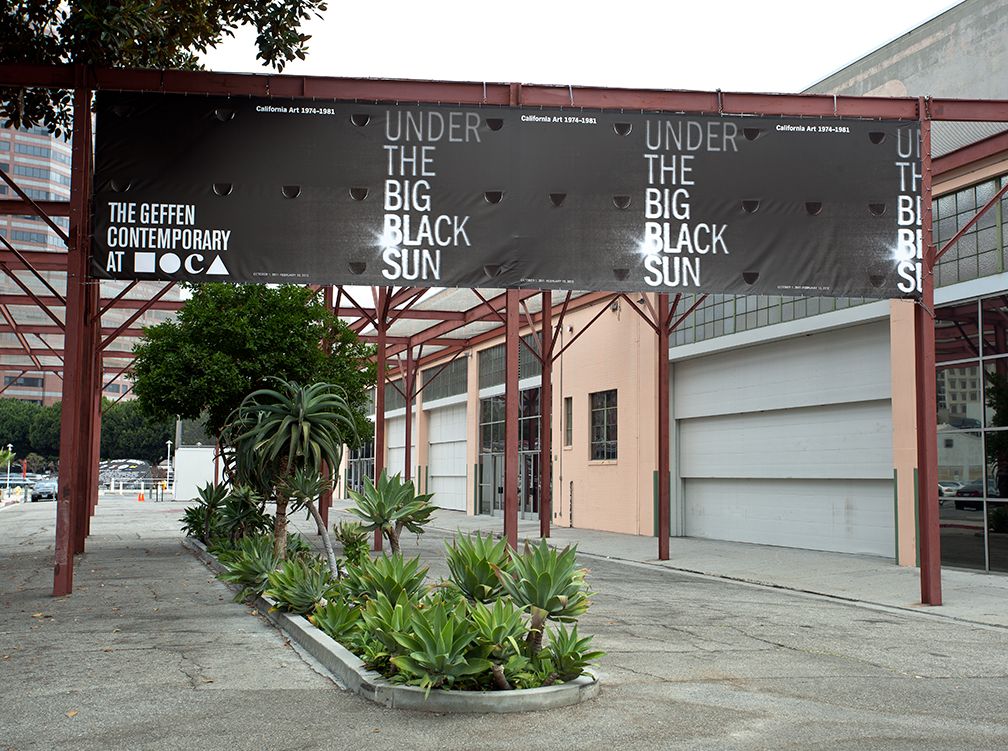
Under the Big Black Sun: California Art 1974-1981, The Geffen Contemporary at MOCA, photo by Brian Forrest.

Listen to MOCA Chief Curator Paul Schimmel speak on the expansive view of art in politics on view at Under the Big Black Sun: California Art 1974-1981

Audio clip: Adobe Flash Player (version 9 or above) is required to play this audio clip. Download the latest version here. You also need to have JavaScript enabled in your browser.

Paul Schimmel will be leading a walkthrough of the exhibition on Thursday, January 26 at 6:30pm. The event is free, no reservations required.

Linda Montano, Mitchell’s Death, 1978

READ MORE »»

MOCA presents X,
with special guestsTHE DEAD KENNEDYS, and THE AVENGERS >>UPDATE: SOLD OUT


Photo by Neil Zlowzower

MOCA’S MEMBERS-ONLY PUNK CONCERT NOW OPEN TO THE PUBLIC!

SATURDAY, JANUARY 28; DOORS AT 6:30PM, SHOW AT 7:30PM
THE GEFFEN CONTEMPORARY AT MOCA

In conjunction with Under the Big Black Sun: 1974–1981, join us for one of the culminating events of The Pacific Standard Time Performance and Public Art Festival—an exclusive concert with three seminal punk rock bands that continue to shape California’s music scene.

SOLD OUT

Visit us at:
MOCA Grand Avenue
250 S. Grand Ave, LA 90012;

and The Geffen Contemporary at MOCA
152 N. Central Ave, LA 90012.

BOX OFFICE HOURS:
MON, 11am-5pm; TUES & WED, CLOSED; THURS, 11am-8pm; FRI, 11am-5pm; SAT & SUN, 11am-6pm.

Not yet a MOCA member? JOIN TODAY
Ticket Prices: $35 Admission, $100 VIP
Non-Member Ticket Prices: $50 General Admission, $120 VIP


Andrew Wilf, Dead Ends, 1980

A leading figure of New Expressionist painting in Los Angeles, Andrew Wilf had a short but influential artistic career. His technique of applying heavily built-up coats of acrylic and wax lends an air of violence to his still-lifes of butchered meat. Residing in a downtown Los Angeles artist loft across from Grand Central Market, Wilf had a direct view onto daily scenes of carnage: bloody parts of cows, sheep, and other animals for sale and the economy of separating the choice cuts from offal and cast-offs.

Blinky, The Friendly Hen

Los Angeles artist Jeffrey Vallance is known for his object-making, installations, writings, performances, and Blinky, The Friendly Hen. Join him for a discussion of his work in the context of Under the Big Black Sun: California Art 1974–1981.

THE GEFFEN CONTEMPORARY AT MOCA
Sunday October 30, 2011
3pm

De-Manufacturing Machine

Mark Pauline of Survival Research Laboratories demos the De-Manufacturing Machine, 1979, on the opening night of Under The Big Black Sun.

Robert Heinecken, Inaugural Excerpt Videograms, 1981


READ MORE »»

SUN SPOTS: KIM JONES ON LOS ANGELES IN THE 1970s.

Erica Wrightson


Artist Kim Jones as Mudman

In advance of their Art Talks, MOCA has asked the artists of Under The Big Black Sun to reflect on living and working in California from 1974-1981. Join San Bernardino-born artist Kim Jones for a discussion of his work in the context of Under the Big Black Sun: California Art 1974–1981.

ART TALK WITH KIM JONES
Sunday October 16, 2011
3pm
THE GEFFEN CONTEMPORARY AT MOCA


MOCA: When you think of the years 1974–1981, what imagery comes to mind?

Kim Jones: Judy, Lorna, Roberta, Ellen, Kathy (no, actually Kathy was before Judy), Nancy, Donna, Betsy, and one woman that I didn’t have sex with. A friend asked if the woman could stay over in my apartment. She flopped on the couch and lay on her side. Staring at me, she laughed for hours. I kept an eye on her all night.

MOCA: What/who were some of your most memorable influences during this period?

KJ: Blowing up model airplanes with Chris Burden, on his studio roof on the boardwalk in Venice. Wilshire Boulevard Walk performance: Drinking whiskey on the street with Bruce Nauman at 11 p.m. Gemini G.E.L on Melrose, where I worked as a nighttime janitor.

MOCA: What was life like in Southern California in the 1970s?

KJ: Easy.

Peter Reiss, Selections from Severely and Profoundly Retarded Individuals, 1978–79


Peter Reiss, TV Portrait, 1979

READ MORE »»

Matt Mullican, Untitled, 1979

Known for performances he stages while under hypnosis, Matt Mullican has had a longstanding interest in exploring states of consciousness. Through works like Untitled, he has sought to communicate his private, internal world in an external, tangible form. Here, Mullican ironically renders his highly personal subjectivity in a generic, graphic, commercially-inspired form. With his last name emblazoned on each panel, the work as a whole functions as a sort of self-portrait of the artist and his creative interests.

CALIFORNIA PLURALISM AND THE BIRTH OF THE POSTMODERN MOVEMENT

Paul Schimmel

Under the Big Black Sun: California Art 1974–1981 addresses the dynamic period in American art when modernism, characterized by a master narrative of progress and succession, reached a dead end, and a multiplicity of movements, forms, and genres began to take shape simultaneously. Indeed, the very notion of art history was called into question during this pluralistic period. As critic Arthur C. Danto explained, pluralism carried with it the “implication that there was no longer any historical direction. That meant that there was no longer a vector to art history, and no longer a basis in truth for the effort to spot the historically next thing.”1 This was partly the result of the individual artist’s own practice—including the spirit of questioning and experimentation occurring in and beyond the studio—taking precedence over affiliation with any group or movement.

In hindsight, pluralism can be seen as one of the most important developments to affect post war art. Moreover, as this exhibition argues vigorously, what cohered as postmodernism during the 1980s in New York effectively codified ideas and concepts evolving from art made in California between 1974 and 1981. Featuring 139 artists working in a wide array of mediums and styles, Under the Big Black Sun examines the exceptionally fertile and diverse production from all across California during this tumultuous transitional period in United States history, which was, incidentally, bracketed by two Presidents from California: Richard Nixon, who left the White House in 1974; and Ronald Reagan, who ascended to it in 1981. The exhibition borrows its title from an album by the Los Angeles–based punk band X to suggest that, during this post-Watergate, post-Vietnam era, disillusionment had eclipsed “California Dreamin’” and hippie optimism. The title also alludes to the plethora of individual art practices, both studio and poststudio, that flourished within this dystopian atmosphere, creating an artistic milieu in which “everything under the sun” was permitted and produced.

READ MORE »»

Eleanor Antin, The Nurse and the Hijackers, 1977


Eleanor Antin, Still from The Nurse and the Hijackers, 1977

READ MORE »»

Henry Rollins’ Five for Under The Big Black Sun

Guest DJ Henry Rollins gave us this preview of his playlist for the Under The Big Black Sun Member’s Opening:

READ MORE »»

John Divola, Zuma Beach, 1977–78


John Divola, Zuma #9 (1978/2006), from Zuma Series, 1977–78

READ MORE »»

Gronk, Twins, 1976

Part of a large series of photographs taken between 1972 and 1978, this portrait of Gronk is more intimate and directly biographical than the murals and political and conceptual performance work for which the artist is better known. During the 1970s, Gronk was involved with artist and performer Jerry Dreva, who inspired him to openly explore his sexuality in his work. For Twins, Gronk photographed himself kissing his own image in a mirror, suggesting an acceptance of and pride in his own identity as a gay man.

Edward Ruscha, The Back of Hollywood, 1977

Edward Ruscha’s The Back of Hollywood is one of several paintings of the iconic Hollywood sign that he made in the 1970s and 80s. The artist has recalled that he used the sign, which was visible from his Venice studio, as an indicator of the weather—if he could see it on a given day, that meant the Los Angeles smog wasn’t so bad. Beginning his career as a commercial artist, Ruscha is perhaps best known for works in which text stands in for his chosen subject. In this work, the Hollywood sign is both text and an actual geographical feature. As he explained, “the Hollywood sign is actually a landscape in a sense. It’s a real thing and my view of it was really a conservative interpretation of something that exists, so it almost isn’t a word in a way—it’s a structure.” The work’s extreme horizontal format and saturated colors are reminiscent of a classic CinemaScope film, such that its subject is imbued with same the glamour and illusion of the movies which helped to make it famous.

Bas Jan Ader, In search of the miraculous, 1975


Bas Jan Ader sailing out of the harbor, Cape Cod, Massachusetts, 9 July 1975

READ MORE »»

Rupert Garcia


Rupert Garcia, Human Rights Day, 1975–7

READ MORE »»